Abstract
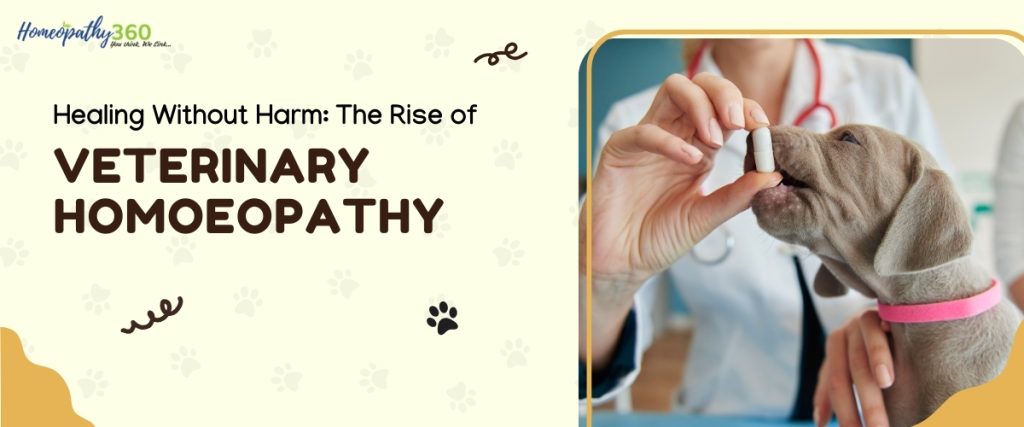
Veterinary homoeopathy, founded on the principle of Similia similibus curentur, has been applied to animal health for over two centuries, following Samuel Hahnemann’s early assertion of its relevance beyond human medicine. Despite its widespread use by some veterinarians and animal owners, veterinary homoeopathy remains a subject of ongoing scientific and ethical debate. This article presents a comprehensive overview of veterinary homoeopathy, examining its historical background, philosophical foundations, regulatory status, and practical applications across multiple animal species, including cattle, sheep, goats, dogs, cats, poultry, horses, pigs, and aquatic animals.
Species-specific disease conditions such as mastitis, foot-and-mouth disease, enterotoxemia, respiratory infections, diarrhoeal disorders, neurological conditions, and parasitic diseases are discussed alongside commonly used homoeopathic remedies based on clinical symptomatology. The article also critically compares homoeopathy with conventional veterinary medicine, highlighting differences in regulatory standards, evidence requirements, and biological plausibility.
Keywords
Veterinary, homoeopathy, potentisation, cattle, poultry, similar, cow, goat, horse, fish, animal, medicine
Veterinary
Homeopathy, founded over 200 years ago on the principle of Similia similibus curentur, was originally developed for human medicine. Samuel Hahnemann anticipated its applicability to animals as early as 1815. Despite this, veterinary homeopathy research remained limited for decades, with only sporadic studies published by a small number of researchers.
Background and Context
Homeopathy is widely used by some veterinarians and animal owners despite ongoing scientific controversy. While it is based on principles such as similia similibus curentur and ultra-high dilutions, these concepts conflict with established biological and pharmacological knowledge. The article addresses growing concerns within the veterinary profession regarding the ethical, scientific, and clinical justification for homeopathic treatments.
Comparison with Conventional Veterinary Medicine
Unlike conventional veterinary drugs, which must demonstrate safety, efficacy, and biological plausibility before approval, homeopathic remedies are exempt from such stringent requirements. The article highlights this regulatory discrepancy and argues that it allows products without proven effectiveness to be marketed and used clinically.
Ethical and Welfare Considerations
A major concern discussed is animal welfare. Since animals cannot consent and placebo effects operate primarily through owner perception rather than direct physiological improvement, reliance on ineffective treatments may delay or replace effective conventional care. This delay can result in prolonged suffering or worsening of disease, raising serious ethical issues.
Implications for Veterinary Practice
The authors argue that veterinarians have a professional responsibility to practice evidence-based medicine. Promoting or using homeopathy without credible scientific support undermines public trust and professional standards. The paper discourages the use of homeopathy as a primary treatment modality, particularly in serious or life-threatening conditions.
Cow
Actinomycosis
It is a common condition in weaned calves, young bulls, and heifers. There is swelling of maxilla and mandible
Heckla lava: Bony swellings on head bones
Acid flour: Ulceration of Skin & caries of bone
Anoestrous
Anoestrous denotes a state of complete sexual inactivity with no manifestation of estrous .
Calc phos: Due to profuse leucorrhoea
Iodum: When ovaries are very small on rectal examination
Pulsatilla: Due to retention of placenta & in Silent heat
Sepia: To regulate estrus Cycle
Botulism
It is caused by anaerobic bacterium and produces symptoms like hind limb weakness, paralysis of limbs, collapse and death.
Gelsemium: Paralytic symptoms of throat, Difficult Swallowing
Plumbum met: Paralysis of fore limb muscles
Conium mac: Paralysis of hind legs
Curare: Muscular Stiffness Difficult in walking of fore limbs
Lathyrus sativus: Peripheral paralysis of throat & mouth
Diarrhoea
Podophyllum: Horrible Offensive, watery, painless diarrhoea
Nux vomica: Slimy & offensive, rumbling noise in bowls
Ars alb: Watery slimy greenish or brownish
Merc sol: When dung is inter mixed with mucus & blood
Verat alb: discharges are frequent & watery. Shooting diarrhoea
Chamomilla: colicky, irritable young animals
Wound / Fly Strike
Calendula: cleanses wounds
Hypericum: nerve-rich wounds
Mastitis
One of the commonest disease in dairy cattle which is due to inflammation of breast tissues.
Arnica: Due to injury with inflammation & swelling
Belladonna: Acute swelling with redness & pain of udder
Apis: With oedema of udder & surrounding tissues
Bryonia: When udder is hard & indurated with fibrosis
Hepar sulph: When matter is forming & bringing swelling to head
Phytolaca: When there is fibrosis
Milifolium: To control intra mammary bleeding.
Echinacea: general infection support
Metritis
Similar to humans, inflammation of uterus in animals occur just after calving or due to complications of labour such as dystocia, retained products of concepts, twin birth or still birth. It has following symptoms – high fever, foul smelling discharge.
Echinecea: Septicaemia with high temp.
Sabina: Metritis due to retention of placenta
Secale: When discharges are dark fluid blood
Lachesis: When bluish discolouration of visible parts
Foot & mouth disease
Common symptoms are – blisters in the mouth, excess salivation, blisters in between toes and above the hoofs, high fever, reduced milk production.
Merc Sol: sores on the tongue, gums, and inside of the cheek. Edges of sores are red. Mouth and tongue remain moist with increase salivation.
Borax: Is the next prominently indicated medicine for managing sores in the mouth in cases of foot – and – mouth disease. The sores are painful and tender in cases needing Borax. The sores may have a tendency to bleed. Bleeding may arise from sores while eating or from touching.
Rhus Tox: Works well in cases of hand – foot – and – mouth disease with blisters that are itchy. The blisters may be filled with clear water, yellow fluid or milky fluid. The skin surrounding the blisters is markedly red.
Nat. Mur: When there is debility and weakness
Hemorrhagic Septicemia
Aconitum: sudden onset, fever, anxiety
Belladonna: hot swelling, congestion
Arsenicum album: collapse, restlessness
Milk Fever (Hypocalcemia)
Calcarea carbonica: weakness after calving
Belladonna: stupor, congestion
GOATS & SHEEP
Enterotoxemia (Pulpy Kidney)
Arsenicum album: diarrhea, weakness
Veratrum album: cold body, collapse
Foot Rot
Silicea: chronic suppuration, cracked hooves
Graphites: sticky discharge
Hepar sulphuris: painful infection
Bloat
Carbo vegetabilis: gas distension
China officinalis: bloating after loss of fluids
DOGS
Canine Distemper
Gelsemium: dullness, weakness
Phosphorus: respiratory involvement
Zincum metallicum: nervous symptoms
Parvoviral Enteritis
Arsenicum album: foul, watery diarrhea
Ipecacuanha: persistent vomiting
Hip Dysplasia / Arthritis
Rhus tox: stiffness better by movement
Calcarea fluorica: joint deformity
Ruta graveolens: ligament involvement
CATS
Feline Upper Respiratory Infection
Hepar sulphuris: purulent nasal discharge
Kali bichromicum: thick, stringy mucus
Pulsatilla: mild symptoms, affectionate nature
Hairball Problems
Nux vomica: retching without result
Lycopodium: digestive sluggishness
Homoeopathy for poultry
Avian tuberculosis
This granulomatous lesion leads to progressive weight loss, ulcers in visceral organs and finally death. It reduces the life expectancy and this is disease is commonly seen in domestic fowl .
Tuberculinum: Muscles of breast reduced in size exposing sternum
Kali phos: Lameness and swelling of joints
Alfa alfa: Comb & wattles appeared pale in colour
Aspergillosis
(Fungal Pneumonia, Pulmonary mycosis) – This allergic fungal disease commonly seen in chickens, turkeys. It affects the respiratory system and produces symptoms of difficulty in breathing, increased respiratory rate, sleepiness, emaciation, increased thirst with involvement of nervous system.
Aconite: Oppressed breathing on least motion, Very sensitive to inspired air. Shortness of breath
Bryonia: Acts on all serous membranes and the membranes of respiratory system especially. Frequent desire to take a long breath
Ars alb: Loss of appetite, increased thirst, gasping & fast breathing
Ant tart: Asphyxia, Rapid, short, difficult breathing; seems as if he would suffocate
Euph & Arg nit: With eye infection
Chronic respiratory disease (C.R.D)
Air Sac Disease.
Ant tart: Sneezing, Coughing
Allium cepa & Euphrasia: Water from eyes
Calc carb: White diarrhoea.
Coccidiosis
This protozoal disease is seen in domestic birds and fowl. The commonest symptom is bloody diarrhoea due to intestinal inflammation.
Merc cor: Birds listless, Bloody droppings
Nux vomica: Pale comb & lack of Appetite
Ipecac: Birds emaciated, diarrhea
Arsenicum album: watery diarrhea, weakness
Fowl pox
Fowl pox (FP) is a viral disease commonly seen in hens, turkeys and other birds, characterized by cutaneous lesions on the feather-less skin and/or diphtheritic lesions of mucous coats of the upper alimentary and respiratory tract .
Ant tart: Lesions on head & Comb are wart like nature
Kali mur: Lesions in mouth are dipthertic type
Aconite: Lesions with fever
Calc phos: Lesions without fever
Fowl Cholera
It is a highly contagious disease caused by the bacterium Pasteurella multocida. It affects chickens, turkeys, and water fowl. The symptoms are diarrhoea, cyanosis, swollen wattles and face.
Rhus tox: Diarrhoea with Swelling of joints of legs, lameness
Kali bich: With Difficult in breathing & thick nasal discharge
Puls: Greenish colour diarrhoea
Gumboro disease
Is seen in chickens which are older than 3 weeks. The main symptom is feces stain in the feathers around the vent. Feces contains plenty of urates.
China: Birds inactive, reduced appetite, feathers ruffled
Kali phos: Watery faeces with high urine content
Berb vulg: Swelling of kidneys marked enlargement of bursa of Fabricius
Marek’s disease (Fowl paralysis) –
The commonest symptoms of this disease includes partial or progressive paralysis of limb with vision impairment. The paralysis can also affect chicken’s neck or wings . Causticum: Paralysis, birds unable to walk & stand
Calc Carb: Skin thickened by tumours, feather follicles thickened & leathery
Arg nit, euph: Iris effected & white appearance
Kali phos: Sciatic nerve is enlarged
New castle disease /Ranikhet disease
The intensity of the symptoms of this disease varies based on the age of the affected birds. Death occurs within a short time after appearance of respiratory symptoms. Death increases in numbers from day to day. Along with respiratory symptoms it also produces nervous signs such as tremors, paralysis and twisting of the neck .
Ars alb: Difficult breathing, opens beak and gasp for breath
Ant tart: Rattling noise & coughing
Actea racemosa: Stiffness and contraction of back & neck.
Gelsemium: Trembling of legs leads to partial or complete paralysis
Mag phos: Twisting of necks (Torticolis) is main Symptom
Lachanthes: Head drawn to one side
Belladonna – sudden fever
Pullorum disease (Bacillary white diarrhoea)
Calc carb: Birds huddle together & exhibit White foamy diarrhoea
Sulph: Adult bird’s loss of appetite, weakness, greenish brown diarrhoea
Homoeopathy for horse
Strains & Sprains
Rhus tox: stiffness after rest, better with movement
Arnica: trauma, sore muscles
Hoof Problems
Silicea: hard, brittle hooves with cracking
Colic
Colocynthis: cramping pain, relieved by pressure
Quine Influenza
Aconitum: sudden fever after exposure
Bryonia: painful cough, worse motion
Eupatorium perfoliatum: bone pains
Laminitis
Belladonna: hot hooves, inflammation
Arnica: trauma-related onset
Sulphur: chronic cases
Tying-Up Syndrome
Rhus tox: muscle stiffness after rest
Arnica: muscle soreness
PIGS
Swine Fever
Aconitum: acute fever
Belladonna: congestion
Arsenicum album: prostration
Greasy Pig Disease
Graphites: thick, sticky skin discharge
Sulphur: dirty skin, chronic eruptions
AQUATIC ANIMALS (Fish)
Fin Rot
Calendula: healing
Silicea: chronic infections
Stress-Related Mortality
Aconitum: sudden shock
Arsenicum album: poor water condition
Conclusion
The development of veterinary homoeopathy is mainly based on the promising results obtained from homoeopathic treatment among cattle and birds. Homoeopathic medicines can be prescribed on the basis of signs and symptoms very quickly in various ailments of animals. According to the European Commission Regulation (EC No 889/2008, Article 24) (European Commission 2008) homoeopathic medicines are promoted for organic agriculture, for treating animals instead of the chemically synthesized medicines provided the homoeopathic therapy is effective for the disease which is intended to treat. The reasons to choose Homoeopathy in treating the animals includes cost effectiveness, it treats most of the routine diseases, it can be prescribed very easily on the basis of symptoms, it is harmless and speedy results are ensued. The article concludes that there is no reliable scientific evidence supporting the efficacy of homeopathy in veterinary medicine. Given the lack of biological plausibility, absence of robust clinical benefit, and potential risks to animal welfare, the authors recommend against its use. They advocate for treatments grounded in sound science, rigorous research, and demonstrable clinical effectiveness.
Reference
Dr. S Sabarirajan and Dr. M Balachandar – Veterinary homoeopathy – International Journal of Homoeopathic Sciences 2022; 6(3): 107-109