Abstract
Obesity is a multifactorial metabolic disorder influenced by genetic predisposition, lifestyle patterns, emotional factors, and constitutional susceptibility. In Homoeopathy, obesity is not viewed merely as excessive body weight but as an outward expression of disturbed metabolism and assimilation. Homoeopathic Materia Medica provides valuable insight into constitutional remedy portraits frequently encountered in obese individuals. This article reviews obesity from a Materia Medica perspective, emphasizing characteristic constitutional remedies and their therapeutic spheres.
Keywords
Obesity; Constitutional remedies; Materia Medica; Homoeopathy; Metabolic disorder
Introduction
The prevalence of obesity has risen markedly worldwide and is associated with several chronic health conditions. Conventional approaches largely focus on dietary restriction and pharmacological intervention, often providing only temporary benefit. Homoeopathy, guided by the principles of Materia Medica, adopts a constitutional approach, addressing the individual’s physical generals, mental disposition, and metabolic tendencies rather than the disease condition alone.¹
• In 2022, 1 in 8 people in the world were living with obesity. 2.5 billion Adults (18 years and older) were overweight. Of these, 890 million were living with obesity.
• As per National Family Health Survey-5 (NFHS-5), one in every four Indians is now having obesity. There are 135 million obese individuals in India. The prevalence of abdominal obesity in the country was found to be 40% in women and 12% in men.
• In 2022, overweight affected around 37 million children under 5 globally, and over 390 million children and adolescents aged 5–19 years were overweight, including 160 million who were living with obesity – 75% of whom live in low- and middle-income countries.
• Obesity and overweight are a major risk factor for non-communicable diseases such as heart disease, stroke, type 2 diabetes, PCOS, and certain cancers (endometrial, breast, ovarian, prostate, liver, gallbladder, kidney, and colon). Therefore, obesity is more effectively defined by assessing its linkage to morbidity and mortality. The current guidelines deal with management of both overweight and obesity.
Concept of Obesity in Homoeopathy
From_over an Hahnemannian viewpoint, obesity represents a chronic constitutional state characterized by disturbed assimilation and metabolic imbalance. It is frequently associated with long-standing miasmatic influences, predominantly of a psoric–sycotic nature. Emotional stress, sedentary lifestyle, and hormonal factors further contribute to the manifestation of obesity. Hence, remedy selection is based on the totality of symptoms rather than body mass index alone.²
Body Mass Index (BMI)
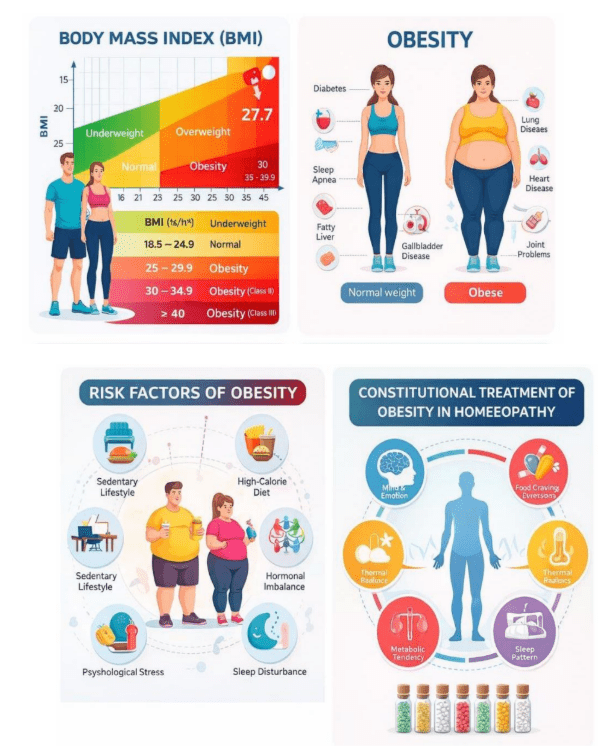
Body Mass Index (BMI) is a simple and widely used anthropometric measurement that helps assess whether a person has a healthy body weight relative to their height. It is commonly used in clinical practice and epidemiological studies to classify individuals as underweight, normal weight, overweight, or obese.
BMI provides an indirect estimate of body fat and helps identify individuals who may be at increased risk for obesity-related diseases such as hypertension, diabetes mellitus, cardiovascular diseases, and metabolic syndrome.
Diagnosis of overweight and obesity is made by measuring people’s weight and height and by calculating the body mass index (BMI). BMI equals the ratio of weight in kilograms divided by height in meters squared (kg/m2): weight (kg)/height (m²).
BMI Classification
The following table represents the standard classification used to assess nutritional status:
| BMI (kg/m²) | Classification |
| Below 18.5 | Underweight |
| 18.5 – 24.9 | Normal weight |
| 25 – 29.9 | Overweight |
| 30 – 34.9 | Obesity Class I |
| 35 – 39.9 | Obesity Class II |
| ≥ 40 | Obesity Class III (Severe or Morbid Obesity) |
Individuals with BMI values above 30 are generally considered obese and are at increased risk of developing chronic diseases. Health Risks Associated with High BMI.
An elevated BMI is associated with several health complications, including:
• Type 2 diabetes mellitus
• Hypertension
• Cardiovascular diseases
• Dyslipidemia
• Osteoarthritis
• Sleep apnea
• Certain cancers
These complications arise due to excess adipose tissue which affects metabolic and hormonal balance in the body.
Limitations of BMI
Although BMI is widely used as a screening tool, it has certain limitations: • It does not directly measure body fat percentage.
• It cannot differentiate between muscle mass and fat mass. • Athletes or muscular individuals may have a high BMI despite low body fat.
• It does not account for fat distribution such as visceral fat.
Therefore, BMI should ideally be interpreted along with other measurements such as waist circumference, waist-hip ratio, and body fat percentage.
BMI in Homoeopathic Perspective
From a homoeopathic viewpoint, BMI is useful for assessing the degree of obesity, but it should not be the sole criterion for prescribing treatment. Homoeopathy emphasizes individualization, where remedy selection is based on the totality of symptoms including mental disposition, food cravings, thermal reaction, metabolic tendencies, and constitutional characteristics.
Thus, while BMI provides an objective indicator of obesity, homoeopathic treatment aims at correcting the underlying constitutional imbalance, which ultimately improves metabolism and assists in gradual and sustainable weight management.
Important Constitutional Remedies
Calcarea Carbonica
Calcarea Carbonica is indicated in obese individuals with sluggish metabolism, easy fatigability, profuse perspiration—especially on the scalp—and marked craving for sweets and eggs. Such patients are generally chilly, anxious about health and future, and slow in both physical and mental activity.³
Phytolacca Berry
Phytolacca Berry is considered in cases of obesity associated with poor fat metabolism and accumulation of adipose tissue. Patients often complain of heaviness, weakness, and sluggish digestion, indicating a disturbed metabolic state.⁴
Natrum Muriaticum
Natrum Muriaticum is useful where obesity is linked with emotional suppression, grief, and stress-related eating habits. These individuals are reserved, crave salt, and exhibit dryness of mucous membranes. Weight gain is frequently associated with emotional factors rather than dietary excess alone.
Kali Bichromicum
Kali Bichromicum is indicated in obesity accompanied by digestive sluggishness, gastric heaviness, and poor assimilation. Patients typically have a round, sluggish constitution with thick, tenacious secretions and a tendency toward chronic digestive complaints.⁵
| S. No. | Medicines | General indications | Characteristic particulars |
| 1. | Ammonium bromatum | Indicated in chronic laryngeal and pharyngeal catarrh, neuralgic headaches, and obesity Malaise and fatigue < lying down, < after emission of flatus while urinating. Nervous restlessness. Pains in legs at intervals, < after motion. | Excessive accumulation of fat. |
| 2. | Ammonium Muriaticum | It is especially adapted to fat and sluggish patients who have respiratory troubles. Large buttocks. Fatty tumours. Obesity. Body fat; legs thin | Excessive fatty deposit around abdomen. |
| 3. | Antimonium crudum | Excessive irritability and fretfulness, together with a thickly coated white tongue. Loss of appetite. Desire for acids, pickles. | Tendency to grow fat |
| 4. | Arsenicum album | It acts on every organ and tissue. Great exhaustion after the slightest exertion. Great thirst; drinks much, but little at a time. Great anguish and restlessness. Chilly patient. | Great exhaustion after the slightest exertion. |
| 5. | Agaricus muscarius | Light hair. Venous erethism. Much hunger, but no appetite; early in morning; stomach feels as if empty. Violent thirst | Old people with indolent circulation. skin and muscles lax |
| 6. | Asafoetida | Nervous women, subject to hysteria. Phlegmatic | Scrofulous, bloated, |
| temperament. Venous, Haemorrhoidal constitutions. Great disgust for all food | clumsy children | ||
| 7. | Badiaga | Scrofulous constitutions. Appetite diminished; costive. Mind generally clear, active in spite of headache. General soreness of the muscles and integuments of the whole body; flesh sore to touch, even of the clothes; sore as if beaten. | Fat children |
| 8. | Baryta carbonica | Chilly patient, mentally and physically dwarfish; timid, weary and lack self confidence, avoid strangers and thinking of complaints makes them worse, better in open air. | Patient with swollen abdomen. Greatly sensitive to cold, have offensive foot sweat |
| 9. | Calcarea arsenica | Suited to lymphatic, scrofulous, and tuberculous persons; fat women, approaching the climaxis; fat persons Slightest emotion causing palpitation. | Fleshy women at climacteric. stomach distended. |
| 10. | Capsicum Annum | Seems to suit especially persons of lax fiber, weak, diminished vital heat. A relaxed plethoric sluggish, cold remedy. Such persons are. General uncleanliness of body | Fat, indolent, opposed to physical exertion, averse to go outside of their routine, get homesick easily |
Role of Individualization
Homoeopathy emphasizes that obesity does not present uniformly in all individuals. Two patients with similar body weight may require entirely different remedies based on mental disposition, food cravings and aversions, thermal reaction, and modalities. Individualization remains the cornerstone of successful homoeopathic prescribing.¹
Discussion
Materia Medica provides a comprehensive understanding of constitutional remedies acting on metabolism, nutrition, and assimilation. Rather than focusing on weight reduction alone, homoeopathic management aims at restoring internal balance, which may result in gradual and sustainable improvement in overall health.
Conclusion
When approached constitutionally through Materia Medica, obesity can be addressed in a holistic and individualized manner. A thorough understanding of remedy portraits enables homoeopathic physicians to manage obesity as a constitutional disorder rather than a mere numerical excess of body weight.
Co-Author
Dr. Gaurang D. Dave, Professor Homoeopathic Materia Medica, C D Pachchigar College Of Homoeopathic Medicine And Hospital, Surat, Gujarat
References
1. Hahnemann S. Organon of Medicine. 6th ed. New Delhi: B. Jain Publishers; 2002.
2. Close S. The Genius of Homoeopathy. New Delhi: B. Jain Publishers; 2001.
3. Kent JT. Lectures on Homoeopathic Materia Medica. New Delhi: B. Jain Publishers; 2004.
4. Boericke W. Pocket Manual of Homoeopathic Materia Medica. New Delhi: B. Jain Publishers; 2007.
5. Allen HC. Keynotes and Characteristics. New Delhi: B. Jain Publishers; 2005.