Abstract
The elicitation of mental symptoms is one of the most critical and challenging aspects of Homoeopathic case taking. Interpretation of Mental symptoms to proper Mind rubrics in Repertory contain a wide spectrum of psychological expressions that reflect the inner state of the patient. The book Homoeopathic Mind Index: A Comparative Study of Mind Rubrics from Kent’s Repertory by Dr. Harshvardhan S. Bhosale attempts to address this challenge by presenting mental rubrics in a systematic, analytical, and clinically oriented format. The book provides definitions, characteristic features, associated clinical conditions, and important remedies for each rubric, thereby helping readers to understand the practical application of mental symptoms in Homoeopathic prescribing. This review article critically evaluates the structure, content, methodology, and academic significance of the book. The work stands as a valuable educational tool for undergraduate and postgraduate students as well as practicing Homoeopathic physicians seeking clarity in the interpretation of mind rubrics and their application in case analysis.
Keywords
Homoeopathy, Mind Rubrics, Kent’s Repertory, Mental Symptoms, Repertorization, Homoeopathic Case Taking, Psychological Symptoms, Comparative Study.
Introduction
Dr. Samuel Hahnemann writes in the Organon of Medicine, the mental state of the patient often reflects the deepest level of disturbance in the vital force. Therefore, understanding the psychological expressions of the patient becomes essential for identifying the similimum.
One of the most widely used repertories in Homoeopathic practice is Kent’s Repertory, compiled by Dr. James Tyler Kent. For undergraduate as well as post graduate students of Repertory knowledge of Kent’s repertory is must for examination point of view and also in clinical practice. The mind section of this repertory contains a large number of rubrics describing various emotional states, behavioral patterns, and psychological conditions. Many rubrics appear similar in meaning but represent different psychological shades. Misinterpretation of these rubrics can lead to incorrect repertorization and ultimately to an inaccurate prescription.
To overcome this difficulty, several authors have attempted to explain and interpret mind rubrics in a simplified manner. In this context, the book Homoeopathic Mind Index: A Comparative Study of Mind Rubrics from Kent’s Repertory by Dr. Harshvardhan S. Bhosale provides an important contribution. The author has attempted to analyze selected mind rubrics systematically and present them in a way that enhances understanding and practical application.
The purpose of this review article is to evaluate the academic relevance, structure, and clinical usefulness of this book. The review also highlights how the book contributes to improving the understanding of mental symptoms in Homoeopathic practice.
Overview of the Book
The book focuses on the interpretation and comparative study of mental rubrics found in Kent’s Repertory. Instead of merely listing rubrics and their remedies, the author attempts to explain the psychological meaning behind each rubric. This approach helps readers understand the deeper significance of mental symptoms and their role in case analysis. The practical application of mind rubrics can be challenging. Many rubrics describe subtle psychological differences. For example, emotions such as jealousy, envy, suspicion, fear, and anger may appear similar but represent different mental states. Without a clear understanding of these distinctions, the physician may struggle to select the appropriate rubric.
The structure of the book is organized in a systematic format. Each mental rubric is explained through multiple components, including:
- Definition of the mental state.
- Characteristic features and behavioral expressions.
- Associated clinical conditions.
- Important homoeopathic remedies related to the rubric.
- Comparative understanding of similar rubrics.
This structured approach makes the book easy to follow and helps readers to develop a clear conceptual understanding of the rubrics.
One of the most notable aspects of the book is its methodological approach. The author adopts a systematic format for explaining each rubric. This approach not only improves clarity but also helps students to learn how to analyze mental symptoms in a logical manner.
The inclusion of definitions provides a conceptual foundation for understanding the rubric. By explaining the meaning of the psychological term, the author ensures that readers clearly understand the mental state being described.
The section on characteristic expressions is particularly useful. It describes how the patient may express the mental state in daily life. These descriptions help physicians recognize similar patterns in clinical practice.
Another important feature is the discussion of associated disease conditions. Many mental states are linked with specific clinical conditions such as anxiety disorders, depression, psychosomatic illnesses, and behavioral disturbances. By highlighting these associations, the book connects psychological concepts with clinical practice.
The explanation of important remedies further enhances the practical value of the book. Each remedy is briefly described with reference to the mental state it represents. This helps readers understand how the rubric is related to remedy selection.
Comparative Understanding of Mind Rubrics
Through comparative discussion, the author highlights these distinctions and clarifies the meaning of each rubric. Such comparative understanding is particularly important for students who are learning repertory for the first time. It also benefits practitioners who wish to refine their skills in case analysis.
Educational Value for Students
The book serves as an excellent educational resource for students of Homoeopathy. Understanding mental symptoms is often difficult during the early stages of learning. The structured explanation provided in this book simplifies the subject and makes it easier to grasp.
The systematic format also supports academic study. Students can use the book as a reference while studying Kent’s Repertory or preparing for examinations. The clear explanations and organized presentation help reinforce conceptual learning.
Furthermore, the book encourages students to think beyond memorization and develop analytical reasoning. By understanding the psychological meaning of rubrics, students can improve their ability to interpret patient symptoms accurately.
These features make the book a practical and informative resource for the study of Homoeopathic Repertory.
Conclusion
The book Homoeopathic Mind Index: A Comparative Study of Mind Rubrics from Kent’s Repertory by Dr. Harshvardhan S. Bhosale represents a significant effort to simplify and clarify the interpretation of mental rubrics in homoeopathy. By presenting rubrics in a structured and analytical format, the author has made an important contribution to homoeopathic education and clinical practice.
The comparative approach adopted in the book helps readers understand subtle psychological distinctions and improves their ability to apply mental symptoms during repertorization. The work serves as a useful guide for students, postgraduate scholars, and practicing physicians who wish to strengthen their understanding of Kent’s mind rubrics.
Overall, this book stands as a valuable academic resource that supports both theoretical learning and practical application in homoeopathic medicine. So I can say every Homeopathic students and teachers must have this book in their library.
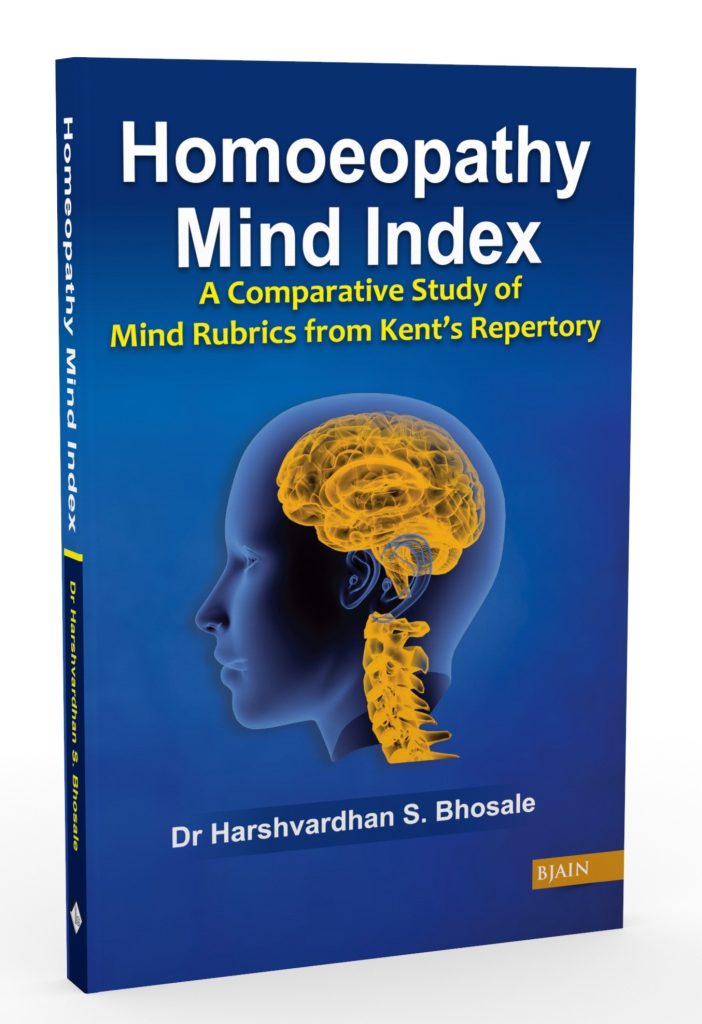
Title – Homoeopathy Mind Index
Author: Dr Harshvardhan S. Bhosale
ISBN: 9788131999363
Imprint: BJain Regular
Pages: 257
Format: Paperback
Language: English
Dr. Khanaj Vidyadhar is Famous Repertory teacher and working in education filed from last 32 years. he is famous Author of books on Repertories like -Reperire-Repertory Simplified, Synoptic card Repertory etc. Dr. Khanaj vidyadhar worked on various P.G. and U.G academic committees of Maharashtra University of Health sciences, Nashik. he is resource person of Repertory for AYUSH Teachers Re-orientation programs.