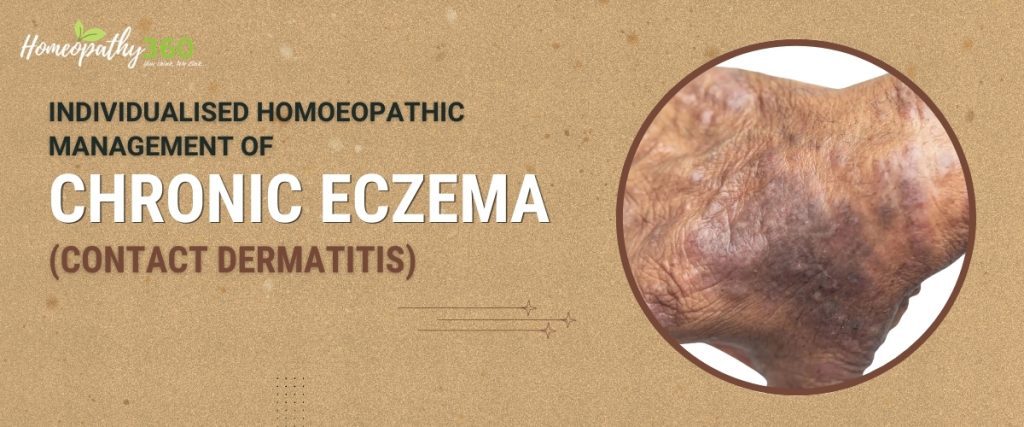
Individualised Homoeopathic Management of Chronic Eczema (Contact Dermatitis): A Case Study
Abstract
Eczema is a chronic inflammatory dermatosis characterised by pruritus, erythema, vesiculation, oozing and lichenification with a recurrent course. Conventional therapy largely focuses on symptomatic suppression with corticosteroids and antihistamines, often followed by relapse. Homoeopathy considers skin disease as an external manifestation of internal dyscrasia and emphasises constitutional treatment based on individual symptom totality. This case report describes the management of a chronic, steroid-dependent eczema case treated with an individualised homoeopathic remedy selected through classical case taking, repertorial analysis and Materia medica correlation. Sustained clinical remission without recurrence over one year demonstrates the scope of constitutional homoeopathy in chronic dermatological disorders.
Introduction
Eczema (dermatitis) represents one of the most prevalent non-infective inflammatory disorders of the skin. It results from epidermal barrier dysfunction, immune hypersensitivity and environmental triggers leading to itching, erythema and exudative lesions. Chronicity develops through repeated inflammation and scratching, producing thickened and hyperpigmented skin (1)
Globally, dermatitis contributes significantly to morbidity by impairing sleep, work productivity and psychosocial wellbeing. (1) Standard dermatological management includes emollients, topical corticosteroids, calcineurin inhibitors and antihistamines. These modalities reduce inflammation but frequently produce temporary palliation; relapse after withdrawal and long-term adverse effects such as cutaneous atrophy are common concerns (2)
Homoeopathy approaches chronic skin disease from a different paradigm. According to Hahnemann, cutaneous eruptions represent an external expression of internal miasmatic disturbance, and suppression may drive pathology deeper. (3) Constitutional prescribing based on the totality of mental, general and particular symptoms aims to restore systemic equilibrium. Kent emphasised that visible lesions should be interpreted in relation to the patient’s individuality rather than treated locally. (4)
Reason for selecting this case
This case was chosen because:
• Longstanding eczema of 7–8 years
• Repeated steroid suppression with relapse
• Occupational exposure aggravating symptoms
• Sustained improvement with a single constitutional remedy
Relevance to Homoeopathy
The case demonstrates classical principles:
• Individualisation
• Totality of symptoms
• Repertorization
• Minimum dose
• Long-term follow-up without suppression
Case History
Patient description
A 48-year-old male, moderately built, employed in an aluminium fabrication unit, presented to the outpatient department with chronic itchy eruptions.
Chronological course
• 7–8 years earlier: small itchy patch over ankle
• Gradually spread to abdomen and waist also
• Treated repeatedly with topical steroid ointments
• Temporary relief followed by recurrence
• Increasing thickness and pigmentation over time
Chief complaints
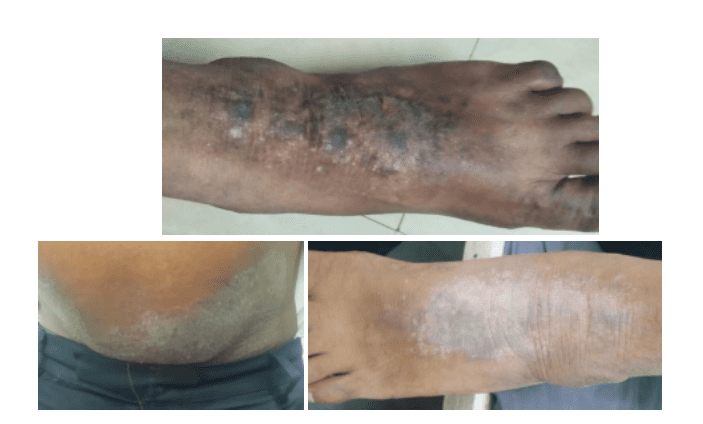
1. Dry, rough, blackish patches over abdomen and left ankle
2. Intense itching, worse evening, and night
3. Scratching followed by sticky discharge
4. Crusting and fissures
5. Winter aggravation
Causation
Occupational exposure to metal dust and perspiration.
Modalities
Worse: night, winter, sweating
Better: washing with cold water
General symptoms
• Appetite: good
• Thirst: 3-4 litters/day
• Urine: clear 3-4 times/day no any complain
• Stool: satisfactory once/day
• Perspiration: profuse upper body
• Thermal: hot patient
• Sleep: sound 6-7 hours
• Dreams: related to God
• Desire: karela (bitter gourd) and bhindi (okara)
Past History / operative procedures
Operated for piles 4 year before
Family History – nothing specific
Mental symptoms
Patient appeared reserved and religious. He stated, “I prefer to pray alone and keep my worries to myself.” Irritable when contradicted but generally mild.
• No anxiety or stress.
• Does not worry much about family matters; believes that everything happens according to God’s will.
• No major personal or financial problems reported.
• States that whatever happens is “God’s wish,” so he does not feel tense about problems. • Leaves his work to fate; rests believing that everything depends on God. • Patient does not stay with his parents due to family issues.
• After his father’s second marriage, his relationship with his step-mother was not good. • Because of this, he feels anger toward his father.
• Easily mixes with other people.
• Maintains good relations with neighbours and friends.
• Desires company.
• Very religious; occupies himself with religious activities.
• Likes to read religious books (such as scriptures) and performs daily prayer/pooja.
• Gets irritated/angry when someone does not act according to his wishes.
• Does not like to share his personal problems with others.
• Believes that his problems should be handled by himself only.
Observation
• Slow speech, timid demeanour, thick dry skin texture.
Diagnosis
Diagnostic reasoning
Chronic pruritic, lichenified plaques with exudation and relapsing course suggested chronic eczema.
ICD-10 Code
L25 – Unspecified contact dermatitis (5)
Differential diagnoses considered
• Psoriasis
• Lichen simplex chronicus
• Fungal infection
Absence of silvery scales, well-defined plaques or fungal margins ruled out these conditions.
Investigations
• Complete blood count – normal
• Blood sugar – normal
• No systemic pathology
Case Analysis & Evaluation of symptoms
Mental generals
• Reserved nature (emotion: grade-1)
• Religious disposition (emotion: grade-1)
• Irritable/angry when contradicted (emotion: grade-1)
• Anger toward father due to past family issues (emotion: grade-1) • Company desired; mixes easily with neighbours and friends (will: grade-1) • Resigned attitude toward life; leaves matter to fate (intellect: grade-1)
Physical generals
• Hot patient (grade-2)
• Worse: night, winter, sweating (grade-3)
• Better: washing with cold water (grade-3)
• Profuse perspiration (grade-2)
Particulars
• Thick, Dry, rough, discoloured eczematous patches on ankle (grade-1) • Scratching → oozing of sticky discharge (grade-1)
• blackish patches over abdomen (grade-2)
• Itching worse night (grade-1)
Miasmatic Evaluation
Chronicity (7–8 years), dryness, thickened skin, itching worse at night, discoloration, and lichenification indicate dominant psoric miasm with sycotic overlay (6)
• Psora → itching, dryness, hypersensitivity
• Sycosis → thickened skin, chronicity, discoloration
Totality of symptoms
• Ailments from grief/anger (family issues)
• Religious
• Carefree/indifferent to anxiety
• Company desire
• Anger when contradicted
• Reserved; does not share grief
• Hot patient
• Upper body perspiration
• Chronic dry eczema
• Itching < night
• Scratching → discharge
Repertorial Totality
Rubrics Selected (Synthesis Repertory)
1. Mind – Religious affections; too occupied with religion
2. Mind – Indifference
3. Mind – Company, desire for
4. Mind – Anger, contradicted; from
5. Mind – grief, silent, indignation; with (family issues)
6. Skin – Eruptions, eczema, chronic
7. Skin – Itching, night
8. Skin – eruption, discharging, viscid
9. Skin – eruption, itching, warmth, agg.
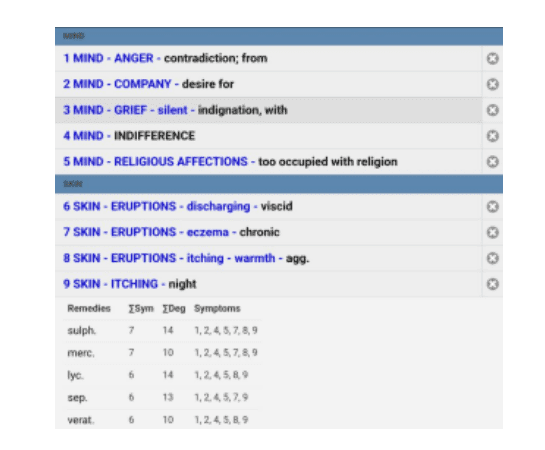
Group of remedy and remedy selection based on Materia medica
Sulphur 7/14
Mercurius solubilis 7/10
Lycopodium 6/14
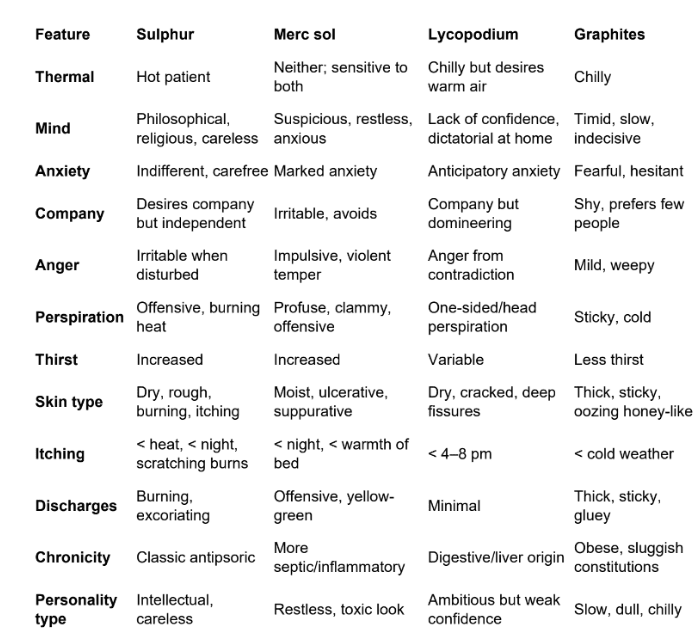
Sulphur covers:
✔ Strong religious inclination
✔ Philosophical, fate-accepting attitude ✔ Neglectful, carefree temperament ✔ Desire for company
✔ Hot constitution
✔ Chronic itching eczema worse at night
✔ Dry, rough, scaly eruptions
✔ Classic antipsoric action
Prescription
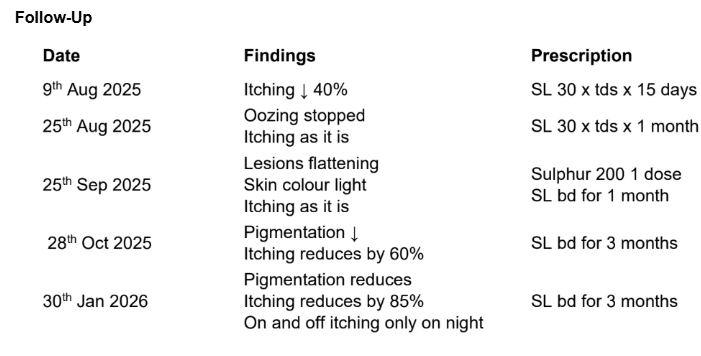
Sulphur 200C – single dose on 26th July 2025
SL 30 x 4pils x tds for 15 days
Conclusion
This case highlights the effectiveness of an individualized homoeopathic approach in the management of chronic eczema. Emphasis on characteristic mental and physical generals, rather than the local pathology alone, enabled accurate constitutional prescribing. Systematic evaluation and Repertorization indicated Sulphur as the Similimum, which corresponded closely with the patient’s religious disposition, carefree nature, hot constitution, and nocturnal itching. Gradual and sustained improvement without suppressive local treatment confirmed the correctness of the prescription. The case reinforces Kent’s principle that mental generals guide remedy selection and demonstrates the scope of classical homoeopathy in chronic dermatological disorders
References
1. Kang S AMBAEAMDMAF. Dermatology. 9th ed. New York: McGraw-Hill; 2019.
2. Goldsmith LA KSGBea. Dermatology in General Medicine. 8th ed. New York : McGraw-Hill; 2012. 3. Hahnemann S. Hahnemann S. Organon of Medicine. 6th ed. New Delhi: B Jain; 2011.
4. Kent JT. Kent JT. Lectures on Homoeopathic Philosophy. New Delhi: B Jain; 2004. New Delhi: B Jain; 2004.
5. World Health Organization. International Statistical Classification of Diseases and Related Health Problems (ICD 10). [Online].; Geneva: WHO; 2016.
6. Hahnemann S. Hahnemann S. The Chronic Diseases: Their Peculiar Nature and Cure. New Delhi: B Jain; 2005.