Abstract:
Rheumatic small joint pain is a challenge to treat especially when rheumatoid arthritis is suspected. Homoeopathy focuses on individualization and Phatak repertory is very useful in cases when clinical and pathological symptomps predominate over mental symptoms. This article presents a case of rheumatic small joint pain with amenorrhea of a 30 years old female successfully treated with individualized homoeopathic medicine guided by Phatak Repertory. This case highlights sphere of action of CAULOPHYLLUM THALICTROIDES on both musculoskeletal system and female reproductive system ,supported by laboratory evidence and clinical improvement.
Keywords:
Small joint pain, Amenorrhea, Phatak repertory, Rheumatoid arthritis, Caulophylum
Introduction:
Rheumatoid arthritis is a disease conditions characterised by joint pain, swelling and stiffness affecting the smal jonts of the hands, feet and wrists in a symmetrical fashion. Large joint involvement, systemic symptoms and extra-articuler features may also occur. The prevalence of RA is approximately 0.8-1.0% in Europe and the Indian subcontinent, with a female-to-male ratio of 3:1.
Amenorrhea refers to the absence of menstrual periods. Amenorrhea is classified into:
1.Primary : Primary amenorrhea is considered when menstrual bleeding has never occurred in the absence of hormonal treatment.
2.Secondary : Secondary amenorrhea is considered if menstrual periods cease for 3-6 months. Primary amenorrhea is a rare disorder that occurs in <1% of the female population. However, between 3 and 5% of women experience at least 3 months of secondary amenorrhea in any specific year.
From homoeopathic point of view we don’t consider particular disease or conditions, we consider the diseased person as a whole. Repertorial analysis plays an important role in selecting similimum. Phatak repertory being concise, clinically oriented, proves to be extremely useful in such cases.
Case Summary:
Name: XYZ
Age: 30 years
Sex: Female
Date:18-08-2024
Chief Complaints:
∙ Pain in small joints of hands and feet since last 10 months.
∙ Wandering, shifting nature of joint pains.
∙ Stiffness of small joints,worse on beginning motion.
∙ Absence of menses since last 6 months.
∙ General weakness and fatigue.
Mental Symptoms:
∙ Irritated easily since this complaints started.
∙ Worried about her complaints.
Past History:
∙ No any major systemic illness.
Family History:
∙ No any such family history.
Physical Generals:
∙ Appetite : Normal
∙ Thirst : 3-4 liters of water/day
∙ Desire : Spicy food +
∙ Aversion : Not specific
∙ Perspiration : Normal
∙ Urine : 5-6 times/day
∙ Stool : Once satisfactory
∙ Sleep : 6-7 hours, sometimes disturbed due to pain
∙ Dreams: Not specific
Local Examination:
∙ Stiffness of small joints, difficult to move.
Investigations:
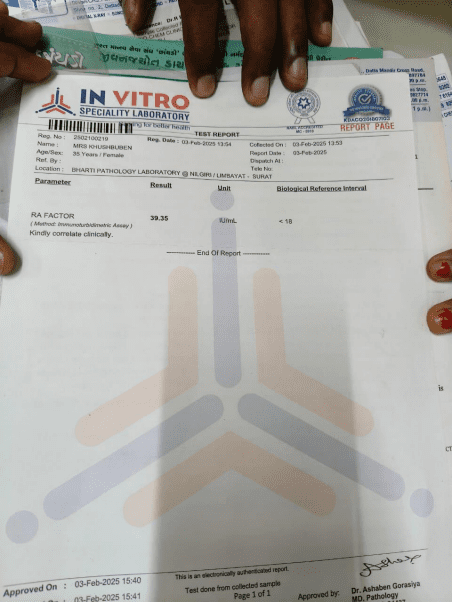
∙ R.A. FACTOR : 273.2IU/ML (18-08-2024) Before treatment ∙ R.A. FACTOR : 39.35IU/ML (03-02-2024) After treatment
Clinical Diagnosis:
Rheumatoid arthritis with Secondary amenorrhoea
Miasmatic Evaluation:
∙ The progressive joint involvement , autoimmune character of rheumatoid arthtritis and menstrual suppression points towards syco-syphilitic miasm.
Totality Of Symptoms:
∙ Pain in small joints.
∙ Wandering, shifting nature of pain.mm
∙ Suppression/Absence of menses.
∙ Rheumatism.
∙ Female patient of reproductive age.
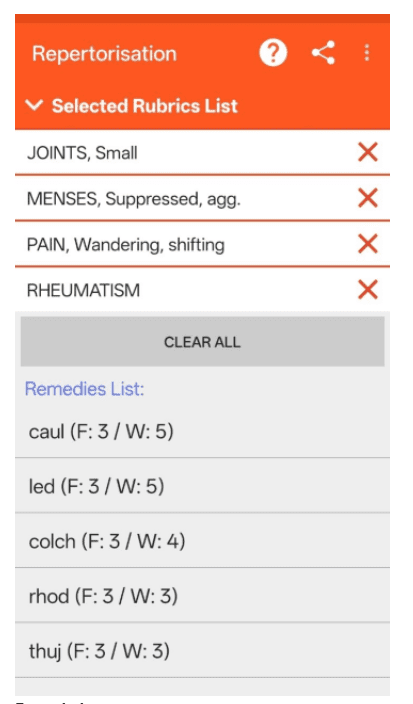
Repertorial Analysis:
Prescription:
∙ Caulophylum 200 one dose
∙ S.L. For 15 days
Caulophyllum was selected because it covers:
∙ Covers small joint rheumatism
∙ Wandering and shifting pains
∙ Suppressed menses
∙ Action on both fibrous tissues + uterus
∙ Matches the clinical totality rather than single rubrics ∙ Supported by both repertory result and materia medica
Follow Up:
1.03-09-2024
∙ Joint pain and stiffness reduced slightly
∙ Menses did not appear
∙ Rx. Caulophylum 200 one dose
∙ S.L. for 1 month
2.03-10-2024
∙ Joint pain and stiffnes better by 50%
∙ Menses did not appear
∙ Rx. Caulophylum 200 one dose
∙ S.L. for 1 month
3.04-11-2024
∙ Joint pain and stiffness better by 80%
∙ There was scanty clotted menstrual flow for 1 day ∙ Rx. Caulophylum 200 one dose
∙ S.L. for 1 month
4.03-12-2024
∙ No joint pain and stiffness
∙ Menses for 3 days with slightly improved menstrual flow ∙ Rx. S.L. for 1 month
5.05-01-2025
∙ Menses regular with normal menstrual flow
∙ No joint pain and stiffness
∙ Rx.S.L. for 1 month
6.03-02-2025
∙ No any complaint
∙ Menses regular with normal flow
Discussion:
This case illustrates the importance of perceiving the patient as a whole rather than only disease or any particular pathology . The correlation between raised Rheumatoid Factor and amenorrhoea highlights the role of immune-hormonal interaction. Homoeopathy, through individualised remedy selection, addresses this deeper level of disorder.
The successful prescription of Caulophyllum validates the effectiveness of Phatak repertory in reaching to the individualised homoeopathic similimum.
Conclusion:
With proper and accurate selection of rubrics and precise and successful use of phatak repertory we can reach to the accurate similimum .From this case I came to the conclusion that Caulophyllum thalictroides should be considered an important remedy in chronic small joint pain associated with menstrual suppression in women.

Refrences:
1.Ralston, Stuart H, et al. Davidson’s Principles and Practice of Medicine. 24th ed.Edinburgh, Elsevier, 2023.
2. Jameson, J Larry . Harrison’s Principles of Internal Medicine. 21st ed., vol. 1, New York Mcgraw-Hill Education, 2022.
3. Hahnemann, Samuel. Organon of Medicine 5 and 6 Edition. B. Jain, 29 Mar. 2013.
4. Phatak, S R, and D S Phatak. A Concise Repertory of Homoeopathic Medicines (Arranged Alphabetically). 2001.
5. Phatak, S R. Concise Materia Medica of Homoeopathic Medicine. New Delhi, B. Jain, 1999.
6. W Boericke. Pocket Manual of Homeopathic Materia Medica and Repertory and a Chapter on Rare and Uncommon Remedies. Wazirpur, Delhi, India, B. Jain Publishers, 1998.
7. Allen, H C. Keynotes Rearranged and Classified with Leading Remedies of the Materia Medica & Bowel Nosodes. B. Jain, 1999.