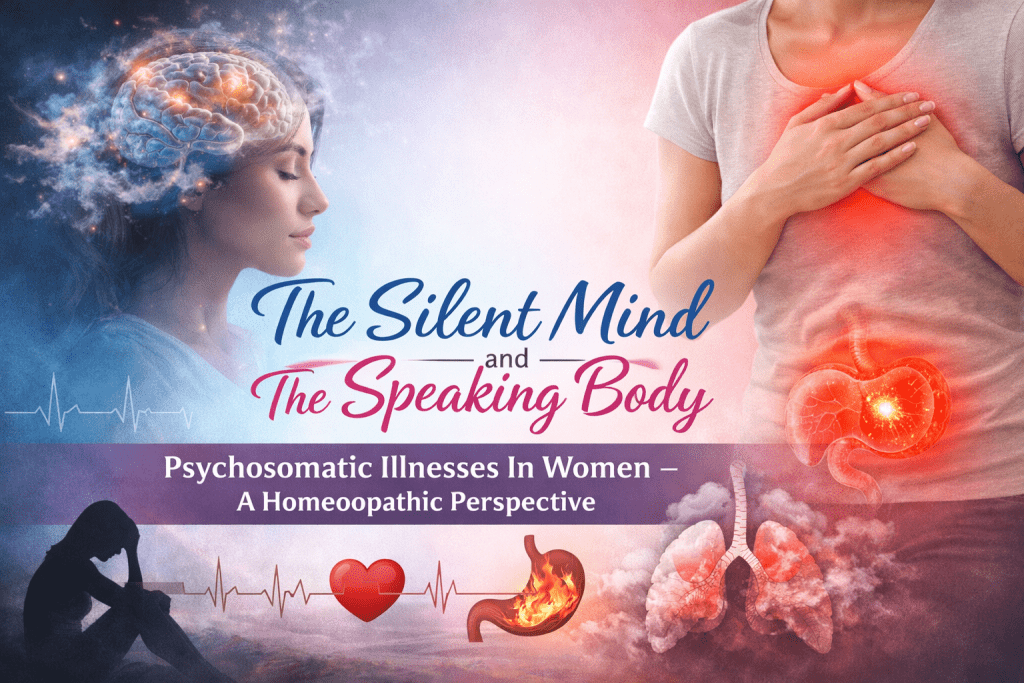
The Silent Mind and the Speaking Body: Psychosomatic Illnesses in Women — A Homeopathic Perspective
Abstract
Psychosomatic illnesses arise when emotional stress, unresolved feelings, and prolonged mental strain influence physical health. In women, emotional suppression, chronic stress, and inner conflict can significantly affect hormonal balance, immunity, and nervous system functioning. Social and cultural conditioning that encourages women to remain emotionally restrained often contributes to this mind–body imbalance.
Homeopathy views disease as a disturbance of the vital force, where emotional and mental factors play an important role alongside physical symptoms. This article explores psychosomatic manifestations commonly observed in women and discusses the relevance of individualized homeopathic treatment in restoring balance by addressing both emotional and physical dimensions of illness.
Introduction
Illness does not always begin in the body. Sometimes it starts in the unspoken parts of our mind, in the conditions we suppress, the conflicts we hide, the words we never say. What the mind tries to silence, the body often begins to express. This is what we call psychosomatic illness, when the body become language of the mind.
Modern medical research increasingly recognizes the close relationship between psychological stress and physical disease. Chronic emotional strain can influence hormonal regulation, immune responses, digestion, and autonomic nervous system balance. In women, this connection is particularly significant due to hormonal fluctuations and social roles that often demand emotional adjustment and endurance.
From childhood, many girls are often taught to be calm, adjusting and pleasing. Anger turns into politeness, sadness into patience, and anxiety into responsibility. Though society praises these qualities, the continuous suppression of emotion become a hidden strain. The prolonged emotional suppression can create internal imbalance, eventually expressing itself through physical illness.
Psychosomatic Manifestations Commonly Seen in Women
Psychosomatic illness does not imply that symptoms are imaginary. These are genuine physical complaints in which emotional factors play a contributory role. Common presentations include:
- Recurrent headaches or migraines
- Digestive disturbances such as acidity, bloating, or irritable bowel symptoms
- Menstrual irregularities and premenstrual syndrome
- Thyroid dysfunction
- Chronic fatigue and generalized body pain
- Skin conditions such as eczema or urticaria
Some women also experience functional urinary symptoms, such as increased frequency or urgency, especially when no clear infection or structural abnormality is found. These symptoms are often observed to worsen during periods of emotional stress or anxiety and are recognized in psychosomatic medicine as stress-influenced functional complaints.
It is important to note that conditions such as uterine fibroids are not considered psychosomatic in origin. However, fibroids are often associated with significant emotional and psychological stress, fear, and reduced quality of life, which may further influence a woman’s overall health and symptom experience.
Risk Factors
Several factors may increase vulnerability to psychosomatic illness in women:
- Long-standing emotional suppression
- Unresolved grief or emotional trauma
- Continuous family or work-related stress
- Relationship conflicts
- Hormonal transitions such as puberty, pregnancy, or menopause
- Over-responsibility and perfectionistic tendencies
- Lack of emotional support or personal space
- When emotional needs remain unmet for prolonged periods, the body may become the medium through which distress is expressed.
The Homeopathic Perspective
Homeopathy views the individual as a complete whole — mind, body, and vital force. Disease is not understood merely as a local physical disorder but as a dynamic imbalance affecting the person as a whole. Emotional disturbances are often seen to precede or influence physical illness.
During homeopathic case-taking, emotional experiences, stress patterns, personality traits, and life situations are explored along with physical symptoms. The remedy is selected based on the totality of symptoms rather than on diagnosis alone.
The following remedies are mentioned as commonly observed clinical patterns in psychosomatic presentations and are not intended as substitutes for individualized homeopathic case-taking.
Some commonly indicated remedies in psychosomatic conditions among women include:
Ignatia amara— Indicated in silent grief, emotional shock, or internal conflict following loss or disappointment. Physical complaints may include frequent sighing, throat constriction, headaches, or menstrual irregularities.
Natrum muriaticum— Suitable for emotionally reserved women who suppress feelings and prefer solitude. Ailments often follow long-standing grief, disappointment, or mental strain.
Sepia officinalis — Helpful in women exhausted by prolonged emotional and physical responsibility. Features include indifference toward loved ones, hormonal imbalance, pelvic heaviness, and chronic fatigue.
Staphysagria — Indicated in suppressed anger, humiliation, or emotional hurt. The patient may appear gentle externally while carrying deep internal distress, often associated with urinary sensitivity or skin irritation.
Lachesis mutus— Suitable for emotionally intense women who feel restricted or suffocated. Commonly associated with hot flushes, premenstrual symptoms, and thyroid disturbances.
Kali phosphoricum — A remedy for nervous exhaustion and emotional burnout following prolonged stress. Useful in weakness, sleeplessness, and nervous hypersensitivity.
Pulsatilla nigricans — Indicated in mild, affectionate women whose symptoms vary with mood and emotional reassurance. Commonly useful in hormonal and digestive complaints.
Calcarea carbonica — Suitable for anxious, over-responsible women with fear regarding health or family. Often associated with fatigue, sluggish metabolism, and thyroid imbalance.
In Essence
Psychosomatic illness reflects the body’s response to emotional overload and prolonged inner conflict. It highlights the imbalance between what is felt and what is expressed. Homeopathy listens to this language of the body and aims to restore harmony by addressing emotional and physical aspects together.
True healing begins when emotions are acknowledged rather than suppressed. While emotional restraint in women is often praised as strength, prolonged suppression can silently affect health. Encouraging emotional awareness, expression, and balance is as essential as medical treatment.
When the mind is allowed to speak freely, the body no longer has to cry out in pain.