Dr. Parag Sharma’s What If the Indicated Remedy Fails? is a thought-provoking and clinically significant contribution to modern homoeopathic literature. This work is especially valuable for practitioners and students who have experienced the all-too-familiar frustration of seeing well-indicated remedies fail to produce expected results.
The book delves into the intriguing question of “What if the indicated remedy fails?”—a challenge often encountered in homeopathic practice. It aims to clarify the practical relationship between remedies by offering comparative insights and clinical experiences. Covering 255 remedies, including lesser-known and Indian-origin drugs, the book illustrates situations where well-selected remedies do not yield results and how to proceed in such cases. The author emphasizes that the true value of Materia Medica lies in its proper use, much like a tool in skilled hands. Compiled with dedication, this work can serve as a practical guide for students and practitioners alike.
Indian drugs such as Atista indica, Aegle marmelos, Cassia sophera, Embelia ribes, and Nyctanthes arbor-tristis; lesser-known remedies like Eupion, Cataria nepeta, DPT, and Levico aqua; nosodes such as Diphtherinum, Malandrinum, Malaria officinalis, and the Osteoarthritis nosode; sarcodes including Oophorinum, Pancreatinum, and Thyroidinum; as well as bowel nosodes like Morgan Pure, Morgan Gaertner, and Sycotic Co. are not only listed but also accompanied by clear clinical indications, equipping practitioners with practical and actionable insights. These remedies, many of which are rarely encountered in conventional repertories or standard materia medica, are presented with an emphasis on their therapeutic utility particularly in challenging cases where well-indicated classical remedies have failed to deliver results.
The book not only clearly outlines remedy indications along with insights on when to use a particular remedy, but also presents numerous clinical cases for practical understanding sourced from experienced practitioners like Dr. Rajan Sankaran, Dr. Prafull Vijayakar, and Dr. J.H. Clarke. These help readers understand remedy differentiation and practical application, enhancing clarity and depth in prescription when the initially indicated remedy fails. The author also incorporates valuable clinical observations from stalwarts like Dr C Hering, Dr J T Kent, Dr W I Pierce. The book contains 44 footnotes, many of which provide valuable and insightful information that enriches the reader’s understanding. These footnotes include clinical tips, remedy differentiations, historical context, and practical observations of various stalwarts.
While the book is undoubtedly a valuable contribution, one area of improvement lies in its inconsistent and potentially misleading citation of sources. The placement of names such as Dr. Dyce Brown, Dr. Farokh J. Master, and Dr. Sunirmal Sarkar immediately after remedy names may wrongly suggest that these individuals are the original authors of the entire content in those sections. This lack of clarity is particularly problematic for students and early practitioners, who might misattribute the clinical insights and indications.
Although the book includes a bibliography of 72 references, it does not clearly connect these references to the corresponding content in the text. To uphold academic transparency and integrity, the book should adopt a clear and consistent referencing style—such as using phrases like “as per Dr. Farokh J. Master” or incorporating footnotes and in-text citations. Without such clarifications, there is a notable possibility of misinterpretation and reduction in scholarly credibility, making proper attribution essential for maintaining the trust and educational value of the work.
In addition to citation concerns, the book lacks uniformity in the presentation of remedies. While the content is rich in clinical insights, the inconsistent structure—varying formats, headings, and styles across different remedies—can make it difficult for readers to follow and compare information effectively. Some remedies are elaborated with clear subheadings, while others appear in a more narrative or unstructured format. This inconsistency affects readability and reduces the overall coherence of the text. For a book intended as a practical guide, especially for students and young practitioners, a standardized format would greatly enhance usability, clarity, and professional appeal.
Another important aspect is the inconsistent attribution of sources for rubrics mentioned under various remedies. While the author has acknowledged sources for some rubrics, many others—despite being specific and clinically significant—are presented without any reference. In several instances, the repertory from which a particular rubric has been taken is not mentioned. This selective citation creates confusion about the origin and authenticity of the information and limits the reader’s ability to cross-verify or further study those rubrics. Consistent referencing of all rubrics—whether from repertories, provings, or clinical experience—is essential. Transparent citation not only enhances academic credibility but also builds trust in the content’s reliability.
In conclusion, What If the Indicated Remedy Fails? is a commendable and enriching resource that addresses a nuanced and often underexplored aspect of homeopathic practice. Despite certain areas needing refinement in academic rigor and formatting, the book remains a valuable contribution to clinical homoeopathy, offering insights that are both practical and thought-stimulating.
Conflict of Interest:
None declared
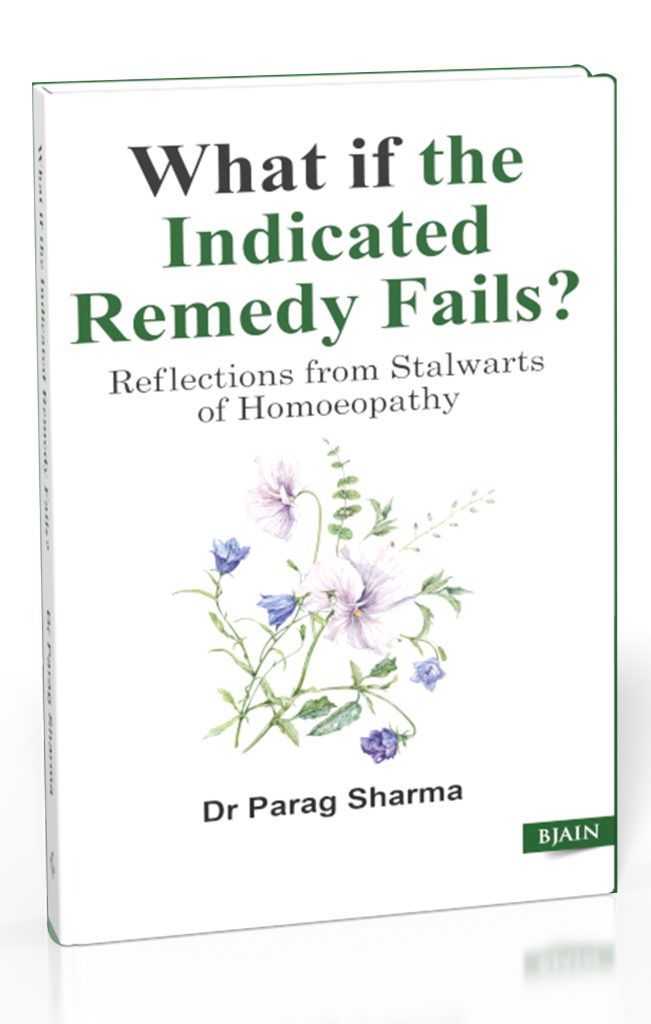
Title: What If the Indicated Remedy Fails?
Author: Dr Parag Sighal
ISBN: 9788131999424
Imprint: B Jain Regular
Pages: 196
Format: Paperback
Language: English
Dr. Lalit Kumar Chauhan is a homoeopath and author, BHMS graduate, MD student at Bakson, and former UP medical officer, with published research in evidence-based homoeopathy.


Dr. Shakti Priya is a dedicated homoeopathic doctor and author committed to advancing homoeopathy through research, education, and clinical practice. She completed her BHMS from Bakson Homoeopathic Medical College and Hospital and is currently pursuing her MD from the same institution. She also holds a Diploma in Nutrition and Health Education (DNHE), enabling her to integrate nutrition into her medical approach. Dr. Shakti regularly contributes articles to professional journals and focuses on providing patient-centered, holistic healing through homoeopathy.