Abstract
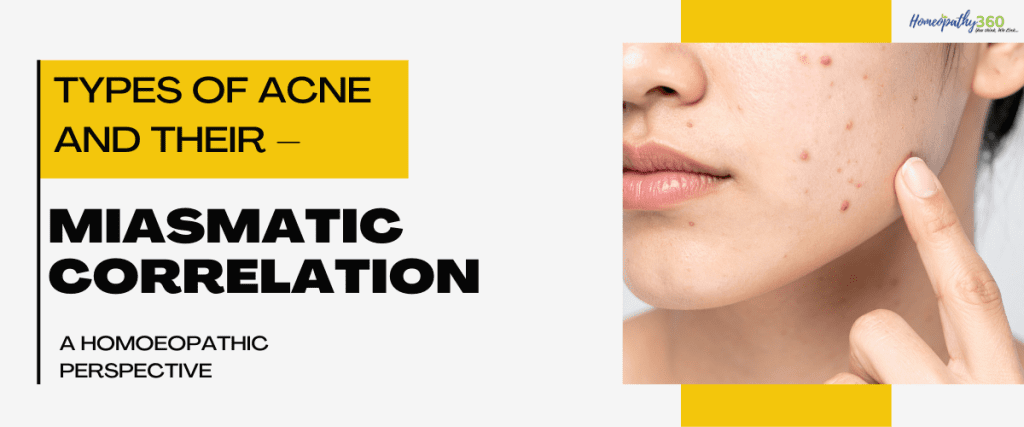
Acne vulgaris is a common chronic inflammatory disorder of the pilosebaceous unit, presenting in varied clinical forms. Homoeopathy considers acne not merely as a cutaneous disease but as an outward manifestation of internal miasmatic imbalance. Different types of acne reflect the predominance of specific miasms such as psora, sycosis, and syphilis. This article attempts to correlate the common clinical types of acne with their underlying miasmatic background, thereby providing a rational basis for constitutional homoeopathic prescribing.
Keywords
Acne vulgaris; Miasmatic analysis; Psora; Sycosis; Syphilis; Homoeopathy
Introduction
Acne vulgaris predominantly affects adolescents and young adults and has a significant psychosocial impact. Conventional medicine classifies acne based on lesion morphology; however, Homoeopathy extends this understanding by recognizing the internal miasmatic influences responsible for chronicity, recurrence, and resistance to treatment. Miasmatic evaluation plays a vital role in selecting the constitutional remedy and achieving lasting cure.
Miasmatic Concept in Homoeopathy
According to Hahnemann, chronic diseases arise from underlying miasms. The three fundamental miasms—psora, sycosis, and syphilis—often exist in combination. Cutaneous manifestations like acne frequently reflect these internal dyscrasias. The clinical expression of acne varies depending on the dominant miasm.
Types of Acne and Their Miasmatic Correlation
1. Comedonal Acne – Predominantly Psoric
Clinical Features:
Open and closed comedones
Minimal inflammation
Oily skin with itching
Miasmatic Interpretation:
Psora manifests through functional disturbances of the skin with hyper-reactivity of sebaceous glands. The absence of deep inflammation and destruction indicates a primarily psoric background.
2. Papular Acne – Psoric with Early Sycotic Influence
Clinical Features:
Red, raised papules
Mild tenderness and itching
Periodic flare-ups
Miasmatic Interpretation:
Psora remains dominant, but early sycotic tendencies appear as localized tissue infiltration and persistence of lesions.
3. Pustular Acne – Sycotic Predominance
Clinical Features:
Pustules with yellowish discharge
Inflammation and induration
Tendency to recur
Miasmatic Interpretation:
Sycosis is characterized by suppuration, infiltration, and overgrowth of tissue. Pustular acne reflects this excessive and persistent inflammatory response.
4. Nodular Acne – Mixed Sycotic–Syphilitic
Clinical Features:
Deep, painful nodules
Hard indurated lesions
Prolonged healing
Miasmatic Interpretation:
The combination of sycotic infiltration with syphilitic tissue damage results in deep seated nodular lesions that are slow to resolve.
5. Cystic Acne – Predominantly Syphilitic
Clinical Features:
Large, painful cysts
Deep suppuration
Scarring and tissue destruction
Miasmatic Interpretation:
Syphilis manifests through destructive processes and ulcerative tendencies. Cystic acne reflects deep pathological changes with a tendency toward permanent tissue damage.
Role of Mixed Miasms in Acne
In most chronic cases, acne does not represent a single miasm but a layered combination. Psora initiates the condition, sycosis sustains it, and syphilis contributes to severity and scarring. Accurate miasmatic evaluation helps in selecting remedies that address the root cause rather than superficial symptoms.
Clinical Significance of Miasmatic Analysis
Understanding the miasmatic background assists the homoeopathic physician in: Managing chronic and recurrent acne
Preventing suppression and relapse
Selecting deep-acting constitutional remedies
Reducing scarring and complications
Conclusion
Acne vulgaris, when viewed through the miasmatic lens, reveals its deeper constitutional origins. Correlating the types of acne with their miasmatic background enables a holistic approach to treatment. Miasmatic analysis remains an indispensable tool in homoeopathic management, ensuring long-term relief and restoration of health.
References
Hahnemann S. Organon of Medicine. 6th ed. New Delhi: B. Jain Publishers; 2002. Hahnemann S. The Chronic Diseases. New Delhi: B. Jain Publishers; 2001.
Kent JT. Lectures on Homoeopathic Philosophy. New Delhi: B. Jain Publishers; 2004.
Close S. The Genius of Homoeopathy. New Delhi: B. Jain Publishers; 2001.
Banerjea SK. Miasmatic prescribing: its philosophy, diagnostic classifications, clinical tips, miasmatic repertory, miasmatic weightage of medicines and case illustrations. 2nd extended ed. New Delhi: B Jain Publishers; 2010.