Abstract:
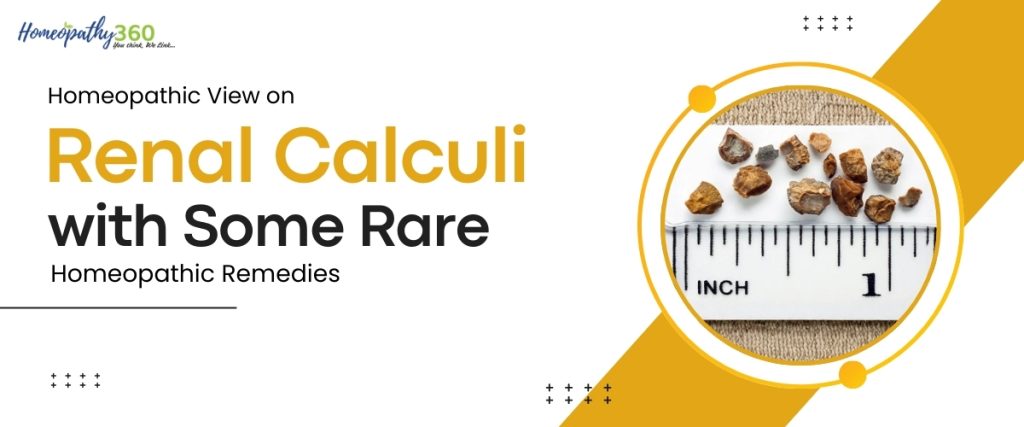
Renal calculi are a common urinary disorder caused by metabolic, dietary, environmental, and hereditary factors that lead to stone formation in the urinary tract. Some patients remain without symptoms, while others experience renal colic and urinary complaints. In homeopathy, renal calculi are understood as a manifestation of underlying miasmatic imbalance, mainly of sycotic origin. This article briefly describes the types, causes, and clinical features of renal calculi, miasmatic expression and given some rare homeopathic remedies.
Keywords:
Renal calculi; Urolithiasis; Homeopathy; Miasm; Renal colic
Introduction:
Renal stone disease is common, affecting people of all countries and ethnic groups. In the UK, the prevalence is about 1.2%, with a lifetime risk of developing a renal stone by age 60–70 of approximately 7% in men. In some regions, the risk is higher, most notably in countries such as Saudi Arabia, where the lifetime risk of developing a renal stone in men aged 60–70 is just over 20%.
| SR. NO | TYPES | ETIOLOGY | PATHOGENESIS | MORPHOLOGY |
| 1 | Calcium stone | Hypercalciuria with or without hypercalcaemia; idiopathic | Supersaturation of ions in urine, alkaline pH of urine; low urinary volume, oxaluria and hyperuricosuria | small (less than a centimetre), ovoid, hard, with granular rough surface. dark brown |
| 2 | Mixed stones | Urinary infection with urea splitting organisms like Proteus | Alkaline urinary pH produced by ammonia from splitting of urea by bacterially produced urease | yellow-white or grey, soft and friable and irregular in shape. ‘Staghorn stone’ |
| 3 | Uric acid stones | Hyperuricosuria with or without hyperuricaemia (e.g. in primary and secondary gout) | Acidic urine (pH below 6) decreases the solubility of uric acid in urine and favours its precipitation | smooth, yellowish brown, hard and often multiple. |
| 4 | Cystine stones | Genetically determined defect in-cystine transport | Cystinuria containing least soluble cystine precipitates as cystine crystals | small, rounded, smooth and often multiple. |
| 5 | Other types | Inherited abnormalities of aminoacid metabolism | Xanthinuria | rare types, <2%, hereditary xanthinuria developing xanthine stones. |
Environmental & Dietary Causes:
Low urine volume:
• High ambient temperatures
• Low fluid intake
Dietary factors:
• High protein
• High sodium
• Low calcium
Excretion abnormalities:
• High sodium excretion
• High oxalate excretion
• High urate excretion
• Low citrate excretion
Acquired Causes
• Hypercalcaemia.
• Ileal disease or resection → increases oxalate absorption and urinary excretion. • Renal tubular acidosis type I (distal).
Congenital & Inherited Causes
• Familial hypercalciuria.
• Medullary sponge kidney.
• Cystinuria.
• Renal tubular acidosis type I (distal).
• Primary hyperoxaluria
Clinical Presentation:
Many patients are asymptomatic.
• Others may present with:
• Pain (acute loin pain radiating to abdomen/groin).
• Haematuria (blood in urine).
• Urinary tract infection (UTI).
• Urinary tract obstruction.
Renal/Ureteric Colic
• Cause: Usually ureteric obstruction by a stone.
• Other causes: Sloughed renal papilla, tumour, blood clot. • Pain features:
• Sudden onset in the loin.
• Radiates to flank → groin → testis/labium.
• Pain intensity rises quickly, peaks in minutes.
• Patient is restless, changes position, paces around.
Associated Symptoms
• Pallor and sweating.
• Vomiting.
• Frequency and dysuria.
• Haematuria.
Duration
• Intense pain usually subsides within 2 hours.
• May persist for hours or days.
• Pain is usually constant during attacks, with slight fluctuations. • After attack: intermittent dull pain in loin/back may last for several hours.
Dietary & Lifestyle Measures:
Fluid
• Aim for ≥ 2 L urine output/day (requires 3–4 L intake).
• Verify with 24-hour urine collections.
• Distribute intake throughout the day, especially before bedtime. Sodium
• Restrict sodium intake (high sodium increases calcium excretion). Protein
• Keep intake moderate, avoid high protein diets.
Calcium
• Maintain adequate dietary calcium (binds oxalate in gut, reduces absorption/excretion).
• Avoid calcium supplements taken separately from meals (increase calcium excretion without reducing oxalate).
Oxalate
• Avoid oxalate-rich foods such as spinach.
Pharmacological Measures
• Thiazide diuretics
Reduce calcium excretion.
Useful in recurrent stone-formers and hypercalciuria.
• Allopurinol
Consider if urate excretion is high (mainly for urate stones; evidence limited). Avoid
• Vitamin D supplements (increase calcium absorption and excretion). • Vitamin C supplements (increase oxalate excretion).
Miasmatic Expression of Renal Calculi And Its Symptoms:
| PSROA | SYCOTIC | SYPHILIS | TUBERCULAR |
| Nephritis, cystitis, pyelitis, urethritis | Renal dropsy, renal calculi, | Pyaemia with oozing of pus | Polyps and papilloma of bladder with haemorrhage |
| Sensation of Fullness in bladder, feeling of constriction, smarting, burning | Stitching and pulsating sensation with wandering pain | Burning and bursting sensation | Tickling sensation |
| Aggravation from cold | Aggravation from damp, rainy weather and from change of weather | Aggravated at night, in summer, from warmth | Aggravation in night |
Some Rare Homeopathic Remedies:
1. CALCAREA RENALIS: Urate of Lime renal calculi. Also, Phosphate of Lime renal calculi.
2. COCCUS CACTI: Urging to urinate; brick-red sediment. Urinary calculi, haematuria, urates, and uric acid; lancinating pains from kidney to bladder. Deep-coloured, thick urine. Dysuria.
3. EPIGEA REPENS: Chronic cystitis, with dysuria; tenesmus after micturition; muco-pus and uric-acid deposit, gravel, renal calculi. Fine sand in urine of a brown colour. Burning in neck of bladder whilst urinating and tenesmus afterward. Pyelitis, incontinence of urine. Croaking noise and rumbling in bowels.
4. ERIGERON: Urination painful or suppressed. Dysuria of teething children; frequent desire; crying when urinating; urine profuse, of very strong odour; external parts (female) inflamed or irritated, with considerable mucous discharge.
5. ERYNGIUM AQUATICUM: Frequent desire to urinate; stinging burning pain in urethra, behind glans, during urination. Must urinate every five minutes; urine dropping away all the time and burning like fire. Renal colic.
6. EUPATORIUM PURPUREUM: Dark-coloured, clear urine. Dark-brown, scanty urine, depositing a whitish, clay-like sediment. Itching of the mons veneris. Deep, dull pain in kidneys. Burning in bladder and urethra on urinating. Insufficient flow; milky. Strangury. Haematuria. Constant desire; bladder feels dull. Dysuria. Vesical irritability in women.
7. FABIANA IMBRICATA: Pichi, A South American shrub cultivated in Southern California. It is a terebrinthine diuretic. It has also tonic and cholagogue properties. Useful in the uric acid diathesis, cystitis, gonorrhoea, prostatitis, dysuria, vesical catarrh with suppurative prostatic conditions; post-gonorrhoeal urinary conditions; cholethiasis and liver affections. Vesical tenesmus and burning after urination. Excoriating urine and calculi.
8. GALIUM APARINE: acts on the urinary organs, is a diuretic and of use in dropsies, gravel and calculi. Dysuria and cystitis. Has the power of suspending or modifying cancerous action. Has clinical confirmation of its use in cancerous ulcers and nodulated tumors of the tongue. Inveterate skin affections and scurvy. Favors healthy granulations on ulcerated surfaces.
9. HEDEOMA PULEGIOIDES: Frequent urging, cutting pains. Pain along the left ureter. Dragging pain from kidney to bladder. Dull burning pain over the left kidney. Burning irritation at the neck of the bladder causing frequent intense desire to urinate and inability to retain urine for more than a few minutes, better urinating.
10. IPOMEA: Pain in left lumbar muscles on stooping. Kidney disorders with pain in the back. Much abdominal flatulence. Aching on top of right shoulder renal colic; aching in small of back and extremities.
11.ONISCUS ASELLUS: Cutting, burning in the urethra. Tenesmus of bladder and rectum, with absence of stool and urine.
12.OXYDENDRON ARBOREUM: A remedy for dropsy-ascites and anasarca. Urine suppressed. Deranged portal circulation. Prostatic enlargement. Vesical calculi. Irritation of the neck of the bladder. Great difficulty of breathing.
13.PAREIRA BRAVA: Black, bloody, thick mucus urine. Constant urging; great straining; pain down thighs during efforts to urinate. Can emit urine only when he goes on his knees, pressing head firmly against the floor. Feeling of the bladder being distended and neuralgic pain in the anterior crural region. (Staph.) Dribbling after micturition. (Selen.) Violent pain in glans penis. Itching along urethra; urethritis, with prostatic trouble. Inflammation of urethra; becomes almost cartilaginous. The paroxysms appear generally from 3 to 6 a.m.;
14.PIPERAZINUM: Uric acid conditions. Pruritus. Gout and urinary calculi. Constant backache. Skin dry, urine scanty.
15.POLYGONUM PUNCTATUM: Inflammation of kidneys from cold. Cutting pains along ureters to bladder. Painful cutting and feeling of strangulation at neck of bladder while urinating, lasting long after Strangury, during an attack of gonorrhoea extremely violent pains on urinating, causing him to tremble and cry. Pulsating pain; and burning in the prostate on urinating. Pain in bladder. Deposit in urine of mucus and phosphates. Frequent and profuse discharge of clear, light, or straw-coloured urine. Albumen.
16.SENECIO AUREUS: Scanty, high-coloured, bloody, with much mucus and tenesmus. Great heat and constant urging. Nephritis. Irritable bladder of children, with headache. Renal colic with or without nausea. Chronic inflammation of neck of bladder with bloody urine and tenesmus of bladder. Chronic inflammation of kidneys. Dysuria: of women and children, evidently of catarrhal origin; mucous sediment in urine; with uterine displacement. Smarting in fossa navicularis before urination. kidney; quantity of urine below normal; urine red, depositing a brick dust sediment; considerable arterial excitement; skin hot and dry; motion caused him to cry out with pain.
17.VESICARIA: Urinary and kidney remedy. Smarting, burning sensation along the urethra and in the bladder with frequent desire to avoid urine often with strangury. Cystitis, irritable bladder.
18.XANTHORIZA APIFOLIA: Shrub Yellow Root-contains Berberine. Dilatation of stomach and intestines, atony, enlarged spleen.
19.XANTHORRHEA ARBOREA: severe pain in kidneys, cystitis and gravel. Pain from ureter to bladder and testicles; pain in small of back returns from least chill or damp.
Single Remedy Rubric From Complete Repertory:
• Bladder; calculi; right kidney, from: SARS.
• Bladder; ulcers; calculi, from: ALL-S.
• Bladder; urination; impossible; calculi, sediment, from: UVA
• Bladder; urination; interrupted, intermittent stream; calculi, sediment, from: UVA • Bladder; weakness; sphincter; calculi going off, after: QUAS.
• Kidneys; calculi, stones; anger, vexation, from suppressed: LACH. • Kidneys; calculi, stones; gallstones, with: BERB.
• Urine; bloody; calculi, with renal: SARS
References:
1.Penman ID, Ralston S, Strachan MWJ, Hobson RP. Davidson’s principles and practice of medicine. 24th ed. [Edinburgh]: Elsevier; 2023.
2. Mohan H, Damjanov I. Textbook of pathology. New Delhi: Jaypee Brothers Medical Publishers; 2019.
3.Boericke W. Pocket Manual of Homeopathic Materia Medica & Repertory. New Delhi, India: B. Jain; 2016
4.John Henry Clarke. A dictionary of practical materia medica: in three volumes. Vol. 1, 2, 3. New Delhi: B. Jain:1904
5. Roger Van Zandvoort. The complete repertory. Leidschendam, The Netherlands: Institute For Research On Homeopathic Information And Symptomatology; 1994.
6.Banerjea Subrata Kumar. Miasmatic prescribing: its philosophy, diagnostic classifications, clinical tips, miasmatic repertory, miasmatic weightage of medicines & case illustrations. New Delhi: B. Jain; 2016.