Abstract
Molluscum contagiosum is a common viral infection of the skin caused by a poxvirus, predominantly affecting children, young adults, and immunocompromised individuals. Clinically, it presents as smooth, dome-shaped, umbilicated papules and is generally regarded as a benign and self-limiting condition. However, persistence, recurrence, and extensive involvement are frequently observed, especially in individuals with altered immunity. Homoeopathy interprets such variability as an expression of individual susceptibility influenced by chronic miasmatic tendencies. This article presents a concise clinical overview of molluscum contagiosum based on standard medical texts, followed by an Organon-centric homoeopathic interpretation emphasizing susceptibility, miasmatic background, repertorial analysis, and individualized therapeutic management.
Keywords : Molluscum contagiosum; Viral dermatoses; Susceptibility; Sycosis; Organon of Medicine; Homoeopathy
Clinical Overview of Molluscum Contagiosum
Molluscum contagiosum is a cutaneous viral infection caused by the molluscum contagiosum virus, a member of the Poxviridae family. The disease is widely prevalent and commonly encountered in pediatric practice, sexually active adults, and individuals with compromised immune status. Transmission occurs through direct skin-to-skin contact, autoinoculation, or indirectly through fomites. In adults, genital involvement is often associated with sexual transmission.
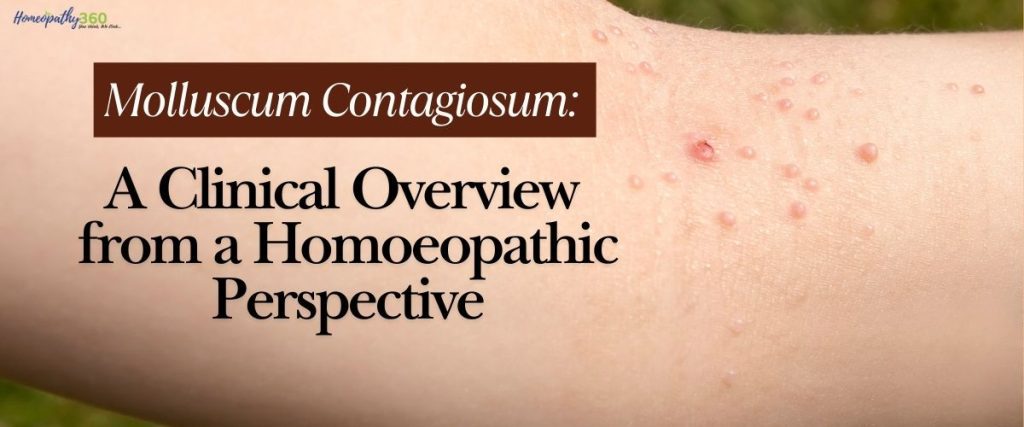
The incubation period varies from a few weeks to several months. Clinically, the disease is characterized by multiple, discrete, smooth, firm papules with a characteristic central umbilication. Lesions are usually skin-colored or pearly white and may occur anywhere on the body except the palms and soles. In children, lesions commonly involve the face, trunk, and extremities, whereas in adults they are frequently localized to the lower abdomen, groin, and genital region.
Although molluscum contagiosum is considered self-limiting, spontaneous resolution may take several months to years. In some individuals, particularly those with impaired immunity, lesions may be numerous, persistent, atypical, and resistant to conventional treatment. Secondary complications such as inflammation, molluscum dermatitis, and bacterial infection may also occur. Diagnosis is primarily clinical, and histopathology, when required, demonstrates characteristic intracytoplasmic inclusion bodies.
Homoeopathic Understanding of Molluscum Contagiosum
From a homoeopathic standpoint, molluscum contagiosum is not viewed merely as a localized viral infection but as an outward manifestation of an internal disturbance of the vital force. While modern medicine identifies a specific viral etiology, homoeopathy emphasizes that the development and course of the disease depend largely upon the individual’s susceptibility.
As explained in the Organon of Medicine, disease arises when an exciting cause acts upon a susceptible organism, resulting in a dynamic alteration of the vital force. This principle explains why exposure to the same virus may lead to spontaneous resolution in some individuals, while others develop persistent or recurrent disease. Homoeopathy therefore approaches molluscum contagiosum as a constitutional disorder with local expression, requiring treatment directed toward the individual rather than the lesion alone.
Miasmatic Interpretation
The doctrine of chronic miasms provides valuable insight into the nature and behavior of molluscum contagiosum. The disease predominantly reflects the sycotic miasm, which is characterized by hyperplastic growths, infiltration, chronicity, and recurrence. The smooth, painless, dome-shaped lesions of molluscum contagiosum closely correspond with sycotic manifestations described in classical homoeopathic literature.
In certain cases, psoric influence may be evident in the form of itching or associated eczematous changes, while syphilitic traits may be observed in severe, destructive, or atypical presentations, particularly in immunocompromised individuals. Accurate assessment of miasmatic predominance is essential for effective and lasting homoeopathic management.
Homoeopathic Therapeutics
Homoeopathic treatment of molluscum contagiosum focuses on the individual as a whole rather than the local lesions alone. Remedy selection is based on constitutional features, susceptibility, and miasmatic background, with the aim of restoring internal balance and promoting natural resolution of lesions. Local destructive measures are generally avoided to prevent suppression and recurrence.
Thuja occidentalis
Thuja occidentalis is regarded as one of the most frequently indicated remedies in molluscum contagiosum, particularly in cases with multiple, smooth, painless growths and a tendency toward recurrence. It is often useful in individuals with a sycotic constitutional background and has been observed to promote gradual resolution without scarring.
Calcarea carbonica
Calcarea carbonica is commonly indicated in children with delayed immune response and sluggish healing. Such individuals may present with recurrent infections and slow resolution of lesions. The remedy supports constitutional strength and improves resistance.
Causticum
Causticum is useful in chronic or long-standing cases where lesions persist despite previous interventions. It is indicated when growths become inflamed or sensitive and when constitutional weakness is evident.
Silicea
Silicea is suited to individuals with poor vitality and delayed healing. It is particularly useful in patients with recurrent infections and a tendency toward chronic skin conditions.
Nitric acid
Nitric acid is considered when lesions bleed easily or when there is evidence of mixed miasmatic influence. It is useful in chronic and relapsing cases.
Medorrhinum
Medorrhinum is indicated in deep-seated sycotic states with extensive or recurrent lesions, especially when there is a strong personal or familial history suggestive of sycotic inheritance.
Remedy selection is individualized, and treatment is aimed at reducing recurrence and improving overall resistance rather than merely eliminating visible lesions.
Conclusion
Molluscum contagiosum, though benign from a conventional medical perspective, illustrates the importance of individual susceptibility and miasmatic influence in disease expression. An Organon-based homoeopathic approach that emphasizes constitutional treatment, miasmatic understanding, and repertorial analysis offers a rational and holistic method of management. By addressing the underlying internal imbalance, homoeopathy aims to promote lasting resolution and prevent recurrence without suppression.
References
1. James WD, Berger TG, Elston DM. Andrews’ Diseases of the Skin: Clinical Dermatology. Elsevier.
2. Rook A, Wilkinson DS, Ebling FJG, et al. Rook’s Textbook of Dermatology. Wiley-Blackwell.
3. Harrison TR, et al. Harrison’s Principles of Internal Medicine. McGraw-Hill.
4. Hahnemann S. Organon of Medicine. B Jain Publishers.
5. Kent JT. Repertory of the Homoeopathic Materia Medica. B Jain Publishers.
6. Boger CM. Boger–Boenninghausen Characteristics & Repertory. B Jain Publishers.