Abstract- Tinea faciei is a superficial dermatophyte infection of facial skin, commonly caused by Trichophyton and Microsporum species¹. It often presents with herpetic, erythematous, itchy lesions. This case report presents a 24-year-old male with recurrent Tinea faciei who responded significantly to individualized homoeopathic treatment with Natrum muriaticum 200. The case illustrates the value of constitutional homoeopathic prescribing in recurrent dermatophytosis².
Keywords- Tinea faciei, Natrum muriaticum, Homoeopathy, Dermatophytosis
Introduction–
Tinea faciei is a dermatophyte infection of the facial region caused mainly by Trichophyton and Microsporum species¹. The condition presents as round, erythematous, scaly lesions accompanied by itching and burning. Recurrence is frequent, especially after misuse of topical corticosteroids².
Homoeopathy aims to treat the whole individual based on the totality of symptoms, in accordance with Hahnemann’s principles described in the Organon of Medicine³. Repertorisation using modern tools like the Complete Repertory 2022 helps in selecting the most individualized remedy⁴.
Case Report:
Patient Information-
A 24-year-old male presented at Girendra Pal Homoeopathic Hospital & Research Centre with red, dry, intensely itchy herpetic eruptions on both cheeks, neck, and behind the ears. The clinical appearance correlated well with typical dermatophyte lesions of Tinea faciei¹,².
History Of Presenting Complaint
The patient was apparently well 3 months ago when he initially developed Eruptions behind the right ear and neck. Later on it spread to cheeks with intense itch and redness without any peculiar discharge. The skin became dry and burning. The patient took allopathic medicines and applied ointment (betamethasone dipropionate cream) for a month and it got better. Later eruptions reappeared covering more area on face after stopping the allopathic medications, area of both side of face, neck and behind the ears with violent itching, burning and redness without any discharge. His Complaint agg. in warmth & heat and he feels better applying something cold on site and in open air.
Past History– Left leg fracture. (Due to road traffic accident -1 year back)
Family History- Mother- Healthy & alive, Father- Healthy & alive Personal History- Nothing specific
Physical General-
- Thermal- Ambithermal
- Cravings- salty food
- Aversions- n/s
- Appetite- 2 meal/day
- Thirst- 2-3 lit/day
- Stool- D2N0, flatulence
- Urine- D4-5N0-1
- Perspiration- on exertion only
- Sleep- 8-9 hours/day, refreshed
Mental General-
Introverted
Easily offended
Lack of confidence
Avoids eye contact
Hasty
Consolation aggravates
Investigation-Advice – CBC, HBA1C, KOH test
Examination-
| Right cheek and neck | Left cheek and neck | |
| Inspection | erythematous and herpetic plaqueNo discharge | Erythematous And herpetic plaqueNo discharge |
| Palpitation | Irregular, rough and dry skin. | Irregular, rough and dry skin. |
| Minute scratch abrasions on face skin due to intense itching | Minute scratch abrasions on face skin due to intense itching |
Diagnosis- Tinea Faciei
Miasmatic Analysis- Symptoms indicated a predominantly Psoric miasm, consistent with itching, dryness, and hypersensitivity described in classic homoeopathic miasmatic theory⁵.
Analysis And Evalutation Of Symptoms-
| Mental general | Physical general | particular |
| IntrovertedEasily offendedLack of confidenceAvoids eye contactHastyConsolation aggravates | T/R-hotCravings-salty food | Intense itchy, erythematous and herpetic plaque eruption on both side of face, neck and behind ears since 3 months without peculiar discharge with uneasiness.agg. in warmth & heat and he feels better applying something cold on site and in open air. |
Totality of Symptoms–
- Introvert
- Easily offended
- Lack of self-confidence
- Hasty temperament
- Consolation aggravates
- Craving: Salt
- Eruptions on cheeks
- Cold and open air ameliorates
- Warmth aggravates
- Violent itching and burning
- Herpetic, erythematous eruptions
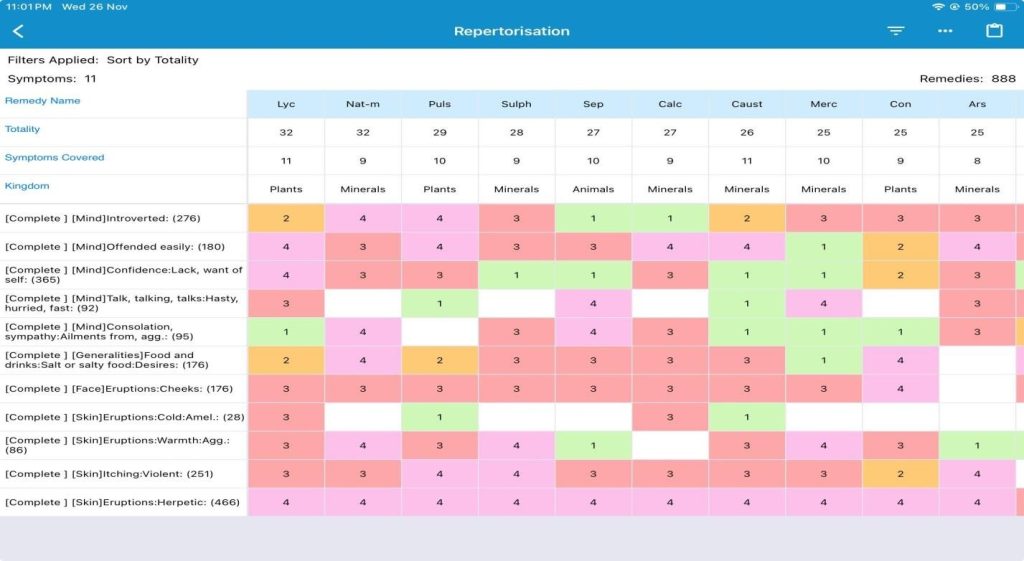
Repertorisation- Rubrics were selected from the Complete Repertory 2022⁴:
- [Complete ] [Mind] introverted: 276)
- [Complete ] [Mind] Offended easily: (180)
- [Complete ][Mind] Confidence: Lack, want of self: 365)
- [Complete ] [Mind] Talk, talking, talks: Hasty, hurried, fast: (92)
- [Complete ] [Mind] Consolation, sympathy: Ailments from, agg.: (95)
- [Complete ] [Generalities] Food and drinks: Salt or salty food: Desires: (176)
- [Complete ][Face] Eruptions: Cheeks: 176)
- [Complete ][Skin] Eruptions: Cold: Amel.: (28)
- [Complete ][Skin] Eruptions: Warmth: Agg.:(86)
- [Complete ][Skin] itching: Violent: (251)
- [Complete l [Skin] Eruptions: Herpetic: (466)
Repertorisation indicated Natrum muriaticum as the highest suitable remedy.
Figure-1: Repertorisation of case from complete repertory using ZOMOEO ELITE.4
Prescription –
Rx-
Natrum muriaticum 200 / single dose
Followed by Placebo 30 TDS
Justification-After repertorisation Natrum muraticum 30/1dose/stat was chosen followed by placebo for 7 days in first visit.
General Management: The patient was advised to maintain hygiene.
Follow Ups:
| Date | Main symptoms/findings | Medicine prescribed |
| 12/10/2023 | Eruptions redness was little better, Violent itching condition was improved | Natrum muraticum 200/1dose /Rubrum 30/tds * 14 days |
| 26/10/2023 | Condition was same as earlier no more improvement in redness anditching. | Natrum muraticum 200/1dose /Rubrum 30/tds * 14 days |
| 10/11/2023 | Improved condition. Little redness, no eruption seen, itching wasmuch less. | Rubrum 30/tds |
| 24/11/2023 | Better eruption. now dry crust appears. | Rubrum 30/tds *7 days |
| 1/12/2023 | Dry crusty eruption is better. his attribution is also better. now he concentrating towards is daily activity. | Rubrum 30/tds *14days |
| 18/12/2023 | All complaints better | Rubrum 30/tds *14 days |
DISCUSSION – Clinical presentation, recurrence pattern, and lesion characteristics were consistent with dermatophytosis described in literature¹². The patient had steroid-induced suppression, a known cause of spread and chronicity².
The combination of physical symptoms and mental generals clearly pointed to Natrum muriaticum. Hahnemann emphasized treating the individual as a whole rather than the disease label³, which is validated in this case.
Miasmatic assessment also matched psora⁵.
This supports the role of individualized remedy selection in chronic dermatophytic infections.
CONCLUSION-
Individualized homoeopathic treatment using Natrum muriaticum resulted in complete recovery of Tinea faciei. This case demonstrates the effectiveness of constitutional prescribing in recurrent fungal infections, supported by literature¹² and classical homoeopathic principles³,⁵.

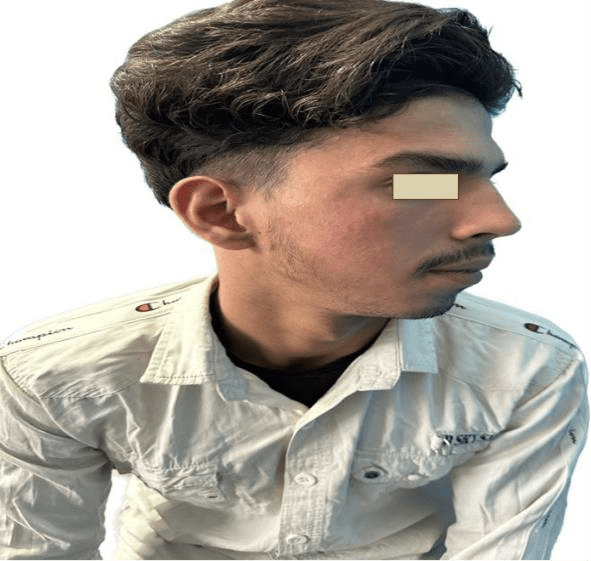
PRE POST
REFERENCES:
- Vaiman, M., Lazarovitch, T., Heller, L. et al. TENUA FASCIA and ecthyma-like lesions: review article. Eur J Clin Microbiol Infect Dis 34, 633–639 (2015). https://doi.org/10.1007/s10096-014-2277-6
- Martínez-Longoria CA, Rosales-Solis GM, Ocampo-Garza J, Guerrero-González GA, Ocampo-Candiani J. TENUA FASCIA: a report of eight cases*. An Bras Dermatol [Internet]. 2017Sep;92(5):698–700. Available from: https://doi.org/10.1590/abd1806- 4841.20175580
- Hahnemann S. Organon of medicine art, 5th edition. New Delhi, B Jain, Publishers; 2010
- Complete repertory 2022, repertory by Roger Zandvoort [Internet]. [cited 2024 Feb 28]. Available from: https://hompath.com/complete-repertory-2022
- Sarkar BK. Hahnemann’s Chronic Diseases. B. Jain Publishers.
About Authors-
Dr. Ashok Yadav, Professor, Department of Practice of Medicine, Dr. M.P.K. Homoeopathic Medical College, Hospital & Research Centre, Homoeopathy University, Jaipur, Rajasthan, India
Dr. Virendra Chauhan, Associate professor, Department of Practice of Medicine, Dr. M.P.K. Homoeopathic Medical College, Hospital &Research Centre, Homoeopathy University, Jaipur, Rajasthan, India
Dr. Yashaswi Choudhary, MD scholar, Department of Practice of Medicine, Dr. M.P.K. Homoeopathic Medical College, Hospital & Research Centre, Homoeopathy University, Jaipur, Rajasthan, India
Dr. Mansi Saini, MD scholar, Department of Practice of Medicine, Dr. M.P.K. Homoeopathic Medical College, Hospital & Research Centre, Homoeopathy University, Jaipur, Rajasthan, India