Abstract:
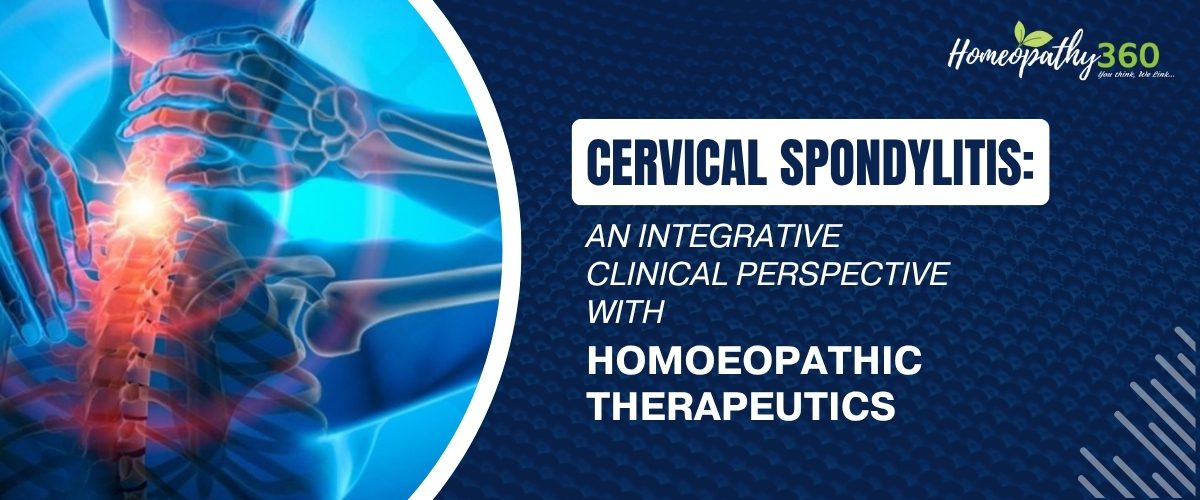
Cervical spondylitis is a chronic degenerative disorder of the cervical spine characterized by progressive deterioration of intervertebral discs, facet joints, ligaments and surrounding neuro-musculoskeletal structures. This article comprehensively reviews the pathophysiology, clinical features, diagnostic considerations and disease progression based on internal medicine understanding consistent with Harrison’s conceptual framework. Homoeopathic treatment is highlighted not merely as symptomatic analgesia but as a constitutional, miasmatic, individualized and structural restorative approach. LM potencies, individualized prescribing, acute flare protocol, and chronic degenerative case management strategy are discussed. Integrative model combining homoeopathy, corrective ergonomics, and physiotherapy is presented as safest long-term curative path.
Keywords: Cervical spondylitis, cervical spine degeneration, homoeopathy, LM potency, degenerative disc disease, radiculopathy.
Introduction:
Cervical spondylitis represents one of the most common degenerative spine disorders globally, most commonly affecting individuals above 35 years and showing increasing prevalence due to digital overuse, posture strain and sedentary lifestyle. Harrison describes cervical degenerative disease primarily as progressive intervertebral disc dehydration, annulus degenerative fissuring, osteophyte formation and altered cervical biomechanics. Neurovascular compromise, radiculopathy, myelopathy and chronic muscular dysfunction are significant consequences requiring multi-dimensional evaluation.
Anatomy & Biomechanics of Cervical Spine:
The cervical spine consists of C1–C7 with maximum mobility at C5-C6 and C6-C7, where degeneration is maximum due to cumulative torsional load and maximum biomechanical stress concentration. Nerve roots C5–C8 involvement produces characteristic upper extremity neurological patterns. Disc degeneration produces segmental instability → ligament hypertrophy → reduced foraminal space → osteophyte formation → nerve compression.
Etiopathogenesis & Pathophysiology:
Degeneration begins with disc dehydration, proteoglycan loss, nucleus pulposus shrinkage and gradual mechanical overloading of facet joints. Subsequent inflammatory mediators accelerate fibrosis and osteophyte formation. Chronic poor posture accelerates axial shear strain forces. Repeated microtrauma produces chronic persistent neuromuscular tension, trapezius spasm, and cervicogenic headache.
Major risk determinants:
- forward flexion prolonged posture
- mobile addiction
- repetitive strain
- age related degenerative cartilage matrix breakdown
- nutritional inflammatory state
- stress mediated muscular tightening
Clinical Features:
- Dull aching cervical pain
- Restricted neck movement
- Morning stiffness improving by movement
- Radiation to shoulder / arm / scalp
- Tingling / numbness upper limbs
- Cervicogenic headache
- Positive foraminal compression tests
- Exacerbation in cold + rest; relief in warm + mild movement
Investigations and Diagnosis:
- X-ray Cervical Spine AP/Lateral (osteophytes, disc space reduction)
- MRI Cervical Spine (radiculopathy, disc prolapse, neural compression)
- EMG/NCS if neuropathic involvement suspected
Differential Diagnosis:
Condition Differentiating Points
- Fibromyalgia multi-site pain + non focal spine signs
- Cervical Myelopathy bowel-bladder, UMN signs
- Shoulder Rotator cuff pathology painful arc, local shoulder only
- Migraine & sinus headache dominant without mechanical neck trigger
Complications:
- Progressive radiculopathy
- Myelopathy
- Chronic neurogenic pain syndrome
- Functional disability and occupational restriction
Management Principles (Modern Integrative):
- Acute flare: short anti-inflammatory support only if very severe
- Chronic stage: posture re-education + ergonomic correction
- Physiotherapy later (not during acute spasm) – Isometric strengthening
- Neuropathic symptoms → avoid traction unless MRI compression proven.
HOMOEOPATHIC MANAGEMENT:
Remedy | Key Clinical Picture | Modality Better | Modality Worse | Miasm Bias |
|---|---|---|---|---|
Rhus Toxicodendron | sprain/strain history, musculo tendinous origin stiffness, need for movement | slow motion, warm applications | first motion, cold damp climate | Psora → Sycosis |
Bryonia Alba | stitching pain, severe aggravation from slightest motion, dryness everywhere | absolute rest, pressure, lying on affected side | motion, jerks, touch | Psora |
Ruta Graveolens | ligament sprain, periostitis, tendinous chronic strain from overwork posture | mild motion, hot fomentation | cold, exposure, long sitting at one posture | Psora-Sycosis |
Calcarea Phosphorica | chronic disc degenerative type, poor bone nutrition, delayed healing | warmth | cold exposure, mental strain, change of weather | Sycosis |
Hypericum | nerve involvement radicular shooting pain, post-whiplash injury neck trauma | gentle rubbing, warmth | sudden jar / concussion | Syphilitic |
Causticum | contracture-like tension, stiffness with progressive weakness, ethical sensitive patients | damp warm weather | dry cold windy | Sycosis-Syphilitic |
Kalmia Latifolia | cervical pain radiating downward to arms/hands with numbness, cardiac-neural link often present | sitting with support | first motion + cold | Syphilitic |
Paris Quadrifolia | sensation as if neck cannot support head weight, cervical + eye strain together | pressure support | mental exertion, reading, computer strain | Psora |
Lac Caninum | alternating side pain, hysterical emotional internal conflict background | change of position sometimes | suppressed emotions, humiliation triggers | Sycotic-psychogenic |
Gelsemium | occipito-cervical heaviness, dull dragging pain with weakness and tremulous feeling | rest + mental relaxation | anticipation, fear before performance | Psora |
Phosphoric Acid | chronic burn out cervical spondylitis after long grief / mental exhaustion | warmth, gentle massage | overexertion mental + physical | Sycosis-Psora |
Chelidonium | RIGHT sided cervico-thoracic pain referring to scapula | warmth | cold | Psora-Sycosis |
Prevention & Ergonomics:
Screen at eye level
low pillow sleeping
mobile eye level protocol
hydration, nutrition anti-inflammatory
daily cervical isometrics 10 min
Conclusion: Cervical Spondylitis is a chronic progressive degenerative spinal pathology with multifactorial biomechanical and inflammatory mechanisms. Homoeopathy provides a unique deeper constitutional and structural correction potential especially using LM dilution scale for chronic degenerative disorders. An integrative model combining homoeopathic individualized constitutional prescribing, ergonomic lifestyle correction and rational physiotherapy offers the safest long-term functional restoration and disease reversal capacity.