The Nucleus—Lectures on Chronic Diseases and Miasms, by Dr.E. S. Rajendran
The Nucleus addresses one of homeopathy’s most enduring and debated terrains, Hahnemann’s theory of chronic diseases, “Miasms and their contemporary relevance in case analysis and chronic disease management”. As the subtitle promises, the book distils a series of lectures into a cohesive text, aiming to help students and practitioners integrate miasmatic analysis with the concept of totality in everyday prescribing. Several catalog and publisher descriptions consistently emphasize this dual aim, deep study of miasm and integration with totality, as the pathway to more precise clinical outcomes.
Readers familiar with Dr. Rajendran’s broader body of work will recognize his effort to connect classical homeopathic philosophy with contemporary scientific sensibilities. His later publications explore nanostructures and potentization, framing homeopathy as a form of personalized nanomedicine; while those are not the subject of The Nucleus, they contextualize the author’s pedagogical voice and his ambition to reconcile tradition with emerging scientific narratives.
What the book contributes
- Re-centering miasms in clinical thinking.
The book offers a focused, practice-facing exploration of miasms—psora, sycosis, syphilis (and their interactions)—and argues that understanding these roots can clarify confusing chronic presentations. This emphasis aligns with descriptions from booksellers and academic notices that present the text as a “deep study” intended for clinical precision.
- From doctrine to bedside: Integrating with totality.
Rather than treating miasms as a historical curiosity, the author persistently brings them into the totality framework. The through line is straightforward: if miasm is fundamental, then it belongs inside—not alongside—case synthesis. That integrative stance is repeatedly highlighted in independent summaries of the book’s intent.
- Pedagogical accessibility.
Because the text originates in lectures, it reads as teaching-in-motion. Early independent reviews noted a “notebook feel” and some repetition—features that can be liabilities for polished prose but often help learners absorb complex conceptual scaffolding. In a classroom or study-group setting, this style can be a strength.
How the argument unfolds
Without reproducing chapter-by-chapter claims, the book’s arc—across descriptions and reviews—can be read as: (a) framing Hahnemann’s chronic disease theory, (b) showing why miasms still matter in modern practice, and (c) offering a working method to read cases through miasm-with-totality rather than miasm-versus-totality. That progression explains why students’ resources and bookseller notes repeatedly pitch it as indispensable for learners and useful for clinicians seeking more consistent long-term results.
The lecture-derived style carries a teacher’s cadence. Key points are reiterated, and the line from philosophical premise to clinical implication is drawn in a way that many undergraduates and new practitioners will welcome. The reception in the professional journal Homeopathy acknowledged this quality even while noting stylistic drawbacks.
Relevance to case management
By cantering miasms within totality, the book doesn’t merely defend a doctrine; it proposes a workflow. For readers who find classical texts conceptually dense, The Nucleus can serve as a bridge from abstraction to case strategy—precisely the benefit underlined in catalog blurbs and educator sites.
Although this volume is philosophical/clinical rather than laboratory-based, its orientation fits Dr E S Rajendran’s broader interest in defending homeopathy’s plausibility in modern terms. That continuity will appeal to readers who follow his later nanomedicine framing of potentization and drug action.
Lecture-to-book translation resulted in a “notebook” quality and repetition in early sections. For some, this will slow the read; for others, it will function like a set of seminar notes that reward annotation. Readers planning to use the text as a teaching tool can embrace the scaffolding—summarize each section into a one-page handout to harness the repetition as a memory aid. As a lecture-based book, the density and uniformity of referencing may vary. When using The Nucleus in postgraduate settings, I would suggest pairing it with up-to-date primary sources to broaden the methodological conversation. (For instance, Dr E S Rajendren’s contemporary work on ultra-high dilutions of homeopathic remedies, imaging and spectroscopic methods)
Relevance for students and practitioners
From a teaching standpoint, The Nucleus can serve as a gateway text into chronic disease reasoning: it keeps Hahnemann on the table, reframes miasms as clinically operational rather than merely historical, and aligns this with the day-to-day discipline of building a totality. For practitioners, the payoff is strategic: the book encourages pattern recognition at the level of disease evolution—the layer at which relapses, suppressions, and remedy adjustments often make or break outcomes. This is precisely why academicians consistently pitch it as “indispensable” for learners and worthwhile for clinicians refining long-term management.
Style and readability
I read the text as teacherly rather than literary. The prose favors functional clarity; the pedagogical rhythm is steady. In places, the lecture origin shows through—especially where points are reiterated with small variations—but that same feature supports spaced repetition in learning. As a reader with a practitioner’s eye, I found that approaching the book with a pen—creating quick “miasm → totality → management” flowcharts—helped convert expository passages into ready-to-use checklists. The independent journal review’s observation about repetition is fair; yet in supervised study circles, this feature can be leveraged rather than lamented.
Suggestions for use in curricula and clinics
- Undergraduate philosophy/organon blocks: Assign selected lectures to precede case seminars; ask students to map how miasmatic thinking modifies remedy selection or follow-up strategy.
- Postgraduate study groups: Pair chapters with contemporary methods papers (case-series methodology, outcome tracking, or—even if one is critical—modern physico-chemical studies on dilutions) to stimulate balanced debate.
- Clinical audit: Use the integration principle “miasm within totality” to re-examine difficult chronic cases; document whether this reframing changes remedy or follow-up decisions over 3–6 months.
The Nucleus is not a glossy monograph; it is a teacher’s book—one that invites you into the classroom where foundational ideas are reworked into clinical habits. Its value lies in how it re-operationalizes Miasms for contemporary practice and reinforces the discipline of integrating them with totality. For students, it offers a structured on-ramp; for practitioners, it provides a reliable prompt to revisit first highly suitable for undergraduate and postgraduate curricula, study circles, and clinicians who want a principled framework for chronic disease management grounded in classical doctrine yet oriented to practice. For academic readers, pairing The Nucleus with current methodological and basic-science literature will deepen the dialogue and balance the lecture-derived style with a broader scholarly apparatus.
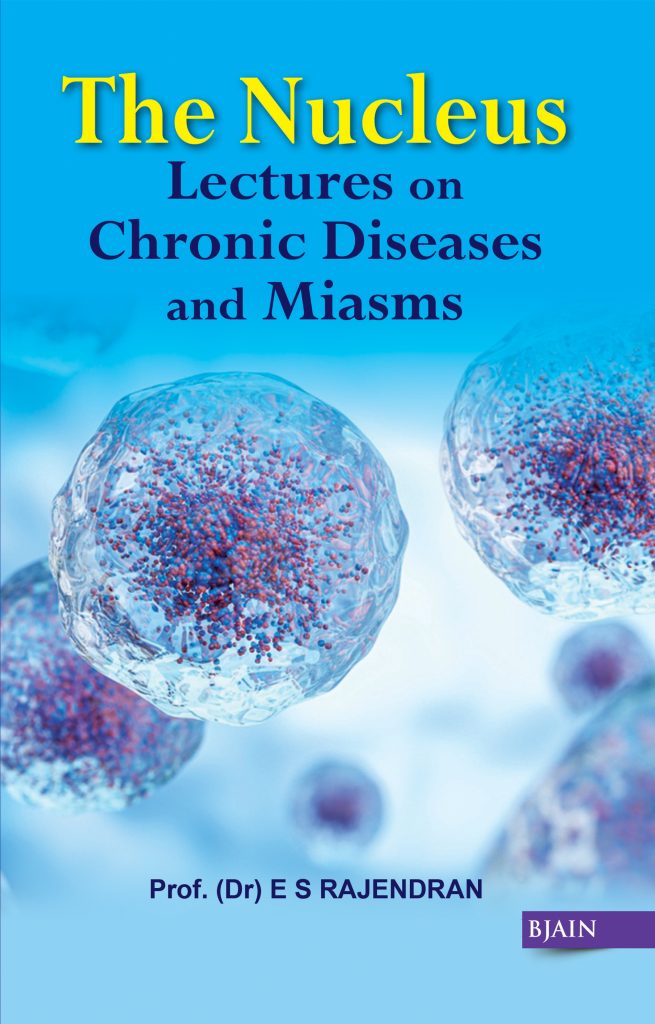
Title: The Nucleus – Lectures on Chronic Diseases and Miasms
Dr Jesly, MD (Hom)
Managing Director ,Mother and child hospital,Kannur, Kerala