Abstract
Herpes simplex is a common viral infection caused by Herpes Simplex Virus (HSV) types 1 and 2, manifesting as painful vesicular eruptions on skin and mucous membranes, often recurring due to viral latency. Conventional treatment offers palliative management with antivirals, whereas Homoeopathy aims at strengthening the host’s immunity and addressing the constitutional predisposition. This article provides a comprehensive overview of herpes simplex, covering its definition, etiology, pathophysiology, clinical features, homoeopathic materia medica, repertory references, and management, supported by authentic sources from Homoeopathic and conventional medical literature.
Keywords
Herpes simplex, Homoeopathy, viral infection, vesicles, materia medica, repertory
Definition
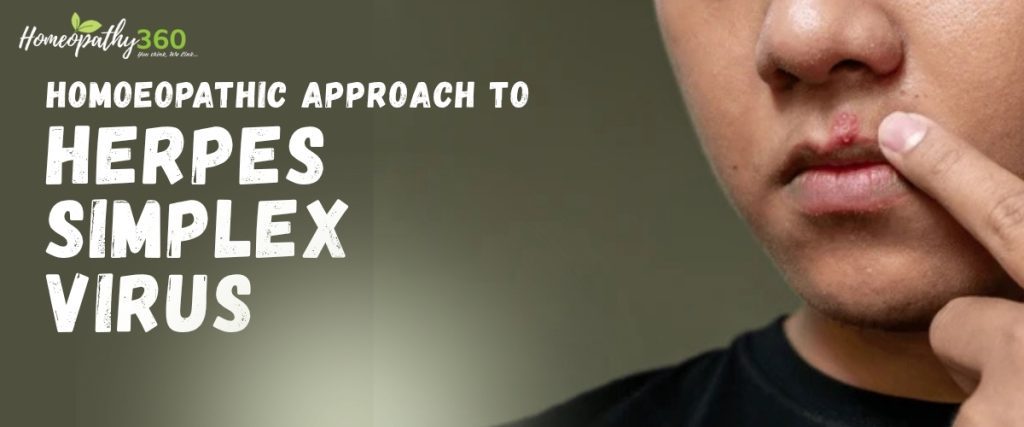
– Herpes simplex is an infectious disease caused by herpes simplex virus type 1 (HSV-1) and type 2 (HSV-2), characterized by recurrent painful vesicular eruptions on the skin, lips, genitals, and mucous membranes.
(Ref: Davidson’s Principles and Practice of Medicine, 23rd Edition; Harrison’s Internal Medicine, 21st Edition)
Etiology
1. Viral cause – Herpes Simplex Virus (HSV-1 and HSV-2), DNA virus of the Herpesviridae family. (Ref: Harrison’s)
2. Predisposing factors – Immunosuppression, stress, fatigue, fever, trauma, hormonal changes (e.g., menstruation).
3. Transmission – Direct contact with infected secretions, mucous membranes, or skin lesions.
Pathophysiology
– Primary infection occurs after viral entry through skin or mucosa, followed by viral replication and appearance of vesicular lesions.
– Virus establishes latency in sensory ganglia (trigeminal ganglion for oral HSV, sacral ganglion for genital HSV).
– Reactivation triggered by stress, immunosuppression, fever, or trauma leads to recurrent outbreaks.
(Ref: Davidson’s, Harrison’s Medicine)
Clinical Features
– Painful grouped vesicles on erythematous base (lips, face, genitalia).
– Tingling, itching, or burning sensation before eruption (prodrome).
– Ulceration, crusting, and healing without scarring.
– Recurrences at the same site.
– Systemic features in severe cases: fever, malaise, lymphadenopathy.
(Ref: Davidson’s Medicine, 23rd Edition)
Homoeopathic Materia Medica
From Boericke’s Materia Medica, Allen’s Keynotes, Clarke’s Dictionary:
– Rhus toxicodendron: Vesicular eruptions with intense itching, burning, and restlessness; eruptions aggravated by cold and wet weather.
– Natrum muriaticum: Recurrent herpes labialis; eruptions around lips, nose; aggravation from heat and sun exposure.
– Graphites: Cracked, oozing eruptions with sticky discharge; tendency to recurrent eruptions.
– Sepia: Recurrent genital herpes in women; associated with hormonal changes, menses; indifference and aversion to sex.
– Mezereum: Vesicular eruptions with burning and itching, worse at night; herpes zoster-like eruptions.
– Arsenicum album: Burning vesicles with restlessness, anxiety, and exhaustion.
Repertory References
From Kent’s Repertory, Boericke’s Repertory, Synthesis Repertory:
– Skin – Eruptions – Herpes
– Face – Eruptions – Vesicular – Lips
– Male/Female Genitalia – Eruptions – Herpes
– Generalities – Recurrence of complaints
Management
1. General measures – Maintaining hygiene, avoiding direct contact during outbreaks, stress management, adequate rest, and balanced nutrition.
2. Homoeopathic treatment – Based on totality of symptoms, individualization, and constitutional approach. Intercurrent remedies may be indicated in recurrent or chronic cases (e.g., Tuberculinum, Syphilinum, Medorrhinum).
References
1. Boericke, W. Pocket Manual of Homoeopathic Materia Medica. B. Jain Publishers.
2. Allen, H.C. Keynotes and Characteristics with Comparisons. B. Jain Publishers.
3. Clarke, J.H. A Dictionary of Practical Materia Medica. B. Jain Publishers.
4. Kent, J.T. Repertory of the Homoeopathic Materia Medica.
5. Davidson’s Principles and Practice of Medicine, 23rd Edition.
6. Harrison’s Principles of Internal Medicine, 21st Edition.